Season 2, Episode 2: Predicting the Future: AI, Corporate Cooperation, Prediction Markets, and Super Bowl Picks
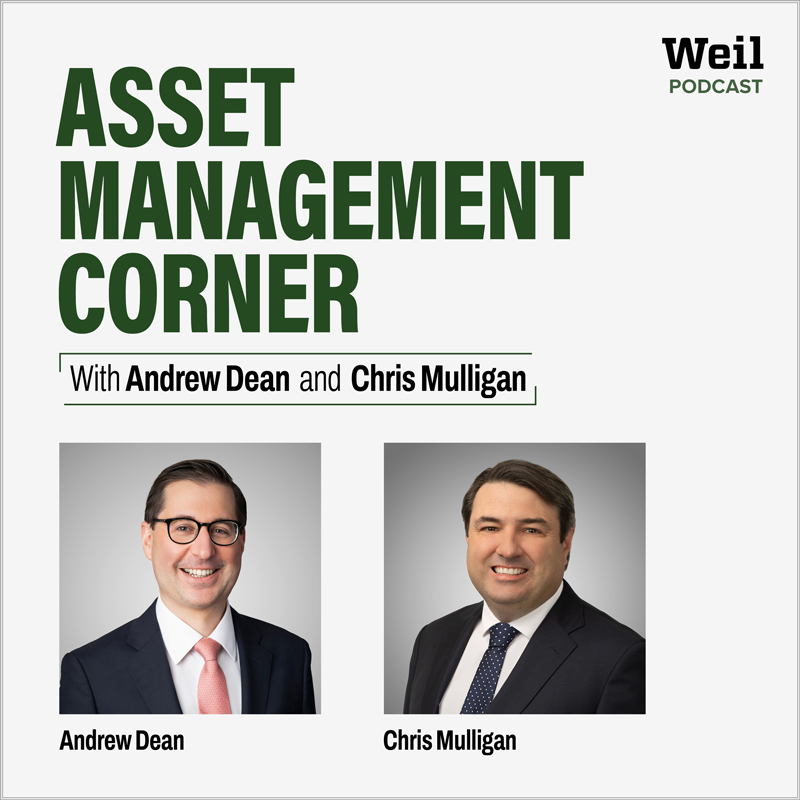
In this Super Bowl edition of Asset Management Corner, Andrew and Chris discuss SEC Director Brian Daly's speech on AI, U.S. Attorney Jay Clayton's interview at the recent Securities Docket conference, where he made news on prediction markets and corporate cooperation, and Andrew’s and Chris’s picks for the big game. They then catch up with friends and colleagues Robert Baker from ACA Group (and a former SEC leader) to discuss SEC exam prep, and Chris Scully from Weil to discuss filing deadlines.
Stream here or subscribe on your preferred podcast app:


Transcript
Andrew Dean: Hello and welcome back to Asset Management Corner. We are your hosts, Andrew Dean and Chris Mulligan, partners at the law firm Weil. This is the podcast where we bring you all things SEC compliance and enforcement. On today's podcast, two good friends and colleagues: Chris Scully, a partner at Weil, and Robert Baker, a managing director at ACA and former SEC leader in both exams and enforcement. Great conversations coming up today.
Andrew Dean: But first, Chris — Super Bowl weekend. This is going to drop after the Super Bowl, so people could hold us accountable for these predictions. What are you looking at in this game, Chris? We got the Hawks as four-and-a-half point favorites. What are you thinking?
Chris Mulligan: I think the Patriots. I’m a Chiefs fan, and I sort of like this idea of royalty — like the Chiefs win, and if it’s not the Chiefs, it should be the Patriots. I kind of like the championship being in the hands of a few teams. I think that’s appropriate, right? I’m not sure Seattle can handle a championship. New England is used to it, similar to Kansas City. So they’re going to pull away with the title this weekend.
Andrew Dean: This is crushing to me, Chris. I wish I had known this previously. I’m a Jets fan, okay? It is crushing to see the Patriots somehow march back to greatness when the Jets can’t even get out of the basement for the last two decades. It has been rough, man. We’ve had very few highlights in my lifetime.
Andrew Dean: I’m a huge Sam Darnold fan. Would love to see Sam do well. Thought it was amazing that the Jets drafted the guy, but, you know, it didn’t work out for a couple of franchises. Glad he’s landed on his feet, as it were.
Andrew Dean: Let’s shift from the Super Bowl predictions to something else. Earlier this week was the Securities Docket Forum, run by Bruce Carton. For those who don’t know, Securities Docket events are SEC enforcement-focused. They happen four times a year, hosted by Bruce Carton, and bring together SEC practitioners for a number of panels. He puts it up on YouTube. It’s a great event and helps track trends at the SEC.
Andrew Dean: The SEC didn’t participate this year, but there was enough practitioner discussion to get a sense of what’s going on, and there were speakers from other agencies like the PCAOB and the U.S. Attorney’s Office. Prominently among them was Jay Clayton, the U.S. Attorney for the Southern District of New York and former SEC Chair during the first Trump administration.
Andrew Dean: Clayton made statements around prediction markets that got a lot of press — along the lines of: if it looks like gambling, it’s probably gambling; if it looks like you’re trading securities on it, then you’re trading securities; and if it looks like insider trading on prediction markets, it sounds like a crime. So we’ll see whether there’s more focus in that space. The CFTC and some prediction market outfits are enhancing their own rules and compliance to try to stave off illegal trading. But it’s something to watch.
Andrew Dean: Another interesting tidbit was that both Jay Clayton and Andrew Thomas — who heads the Securities and Commodities Task Force at SDNY — talked about a new initiative in which companies that might self-report or cooperate in criminal probes would not get prosecuted. Companies have been waiting for a more robust definitive policy around that, and we’ll see if the SEC follows suit. It’ll be interesting to see the actual SDNY proposal when it comes out.
Andrew Dean: There haven’t been a ton of enforcement matters since we last recorded. One I wanted to discuss — in part because last time there was no administrative summary and the resolution just dropped — is Engaged Capital. This brings back SPACs, which got attention in the last administration.
Andrew Dean: The case involved an investment adviser that, as part of a SPAC transaction, invested client assets into SPAC transactions that increased the potential value of investments related to that SPAC previously made by the adviser and its clients (e.g., founder shares and similar early-stage interests). Engaged did not disclose that when it invested client assets later into the SPAC, there was a conflict of interest given that prior investment — which was more weighted toward the adviser and its personnel than its clients.
Andrew Dean: The big takeaway: conflicts of interest are live. That is the evergreen issue — conflicts, conflicts, conflicts. The SEC will continue to focus on that. These conflict cases happened under the Gensler Commission, they’re happening in this Commission, and we’ll continue to see them.
Andrew Dean: That’s the enforcement update. Chris, what do you have on the exam or regulatory side?
Chris Mulligan: We have to have an AI section of every podcast. We do have interesting comments from a speech by the Director of Investment Management, Brian Daley, in remarks to the ICI. We interviewed Mike Spratt from ICI in our last podcast, and shortly after that Brian Daley spoke at their annual meeting about AI. His comments reflect the internal debate likely happening within the SEC.
Chris Mulligan: He focused on two topics. First: the use of AI in the investment process. Brian was optimistic about using AI in investing. He talked about how every time a new technology comes along, everyone panics — that happened with high-frequency trading and algorithmic trading — and eventually there are systems and protections that end up benefiting investors. His view was we should embrace this technology rather than fear it, while recognizing there is regulatory work to do.
Chris Mulligan: He also made a thoughtful point: with quantitative strategies, a key safeguard was keeping a human in the loop to pull the plug in real time if models misbehave. But AI is different. The goal of AI is to take the human out of the loop — at least out of the real-time response loop. Humans will still be involved, but more remotely and in a supervisory role. That’s an important distinction in thinking through regulatory safeguards.
Chris Mulligan: He also emphasized that the best way to deal with these issues is engagement — hear from registrants: come talk to us, tell us how you’re handling these issues. He’s approaching it with an open mind.
Chris Mulligan: Second: AI’s potential benefits for investor disclosure. He raised the idea of using AI tools so investors can ask disclosure documents practical questions: What are you investing in? What fees do I pay? How do I redeem my shares? The SEC has long wrestled with disclosing everything while keeping disclosure useful — longer documents are harder to digest. His vision is that technology could help investors find the information they care about in long disclosures.
Chris Mulligan: Overall, I thought the comments were thoughtful — recognizing risks but not being scared of innovation. These tools are coming, and the SEC seems focused on regulating them in a practical way.
Andrew Dean: On the first point — AI in the investment process — the request for engagement is spot-on and needs to happen. We get questions from clients about how AI can be used appropriately. But the invitation to engage doesn’t mean firms can do whatever they want right now. There still need to be controls and safeguards, fiduciary duty overlays, and firms should be mindful that what one Commission does may not be the position of a future Commission. We’ll keep paying attention and try to engage with Investment Management and others, and pass along insights.
Chris Mulligan: Moving to the interview section: we have two great guests talking about two important issues. We’ve been seeing a very active exam schedule, and we get constant questions like: how do I prepare for an exam? Should I wait for notice to start preparing? What should I do?
Chris Mulligan: We wanted to share practical tips, so we’re joined by Robert Baker. Robert was in the Division of Enforcement and the Division of Examinations during his SEC career, and after leaving he became co-lead of ACA’s mock examination team, helping registrants prepare for SEC exams. Robert, thanks for coming on.
Robert Baker: Thanks for having me.
Chris Mulligan: Robert, we hear a lot about opening day decks. Can you explain what an opening day deck is, whether it’s required, and how firms should prepare for it in the context of an SEC examination?
Robert Baker: To set the stage, opening day decks are sometimes requested by the exam team as part of the document request — often request number one. The Private Funds Unit in particular will almost always request it. Other examiners will request it too, though some don’t.
Robert Baker: We recommend clients prepare a current opening day deck and offer to present it even if it isn’t requested. The deck typically covers: a description of the business; org charts and who works there; investment strategies; for private funds, descriptions of the funds, vintage year, and similar information; and an overview of portfolio management, trading, and risk management.
Robert Baker: But the most important part is the compliance section: the compliance team explains which risks don’t apply to the firm, which risks do apply, and how the firm controls for those risks. That helps set the stage and can help the exam team risk-scope the exam.
Chris Mulligan: We often get asked: can firms just use their investor marketing deck? Is that something you recommend, or should it be more tailored?
Robert Baker: In mock exams we often see something that looks like a marketing deck — sometimes with footnotes and disclosures. It can be a good starting point, but you need to move beyond that. This isn’t a sales presentation. There will be overlap — firm overview, strategy, personnel — but the meat of the opening day deck is the compliance risks, and that’s not something you’d usually see in an investor deck. That’s where you get the most value.
Chris Mulligan: Can you talk about document production? There are a lot of document request lists out there. It can be overwhelming. How should firms pre-prepare for large document productions from exams?
Robert Baker: The SEC often uses template document requests — separate templates for private funds, wealth managers, and so on — and they can be voluminous regardless of how the exam is risk-scoped. Firms sometimes do mock exams or at least review current request lists to see how well they can assemble a production and get feedback from consultants or law firms.
Robert Baker: One key point: the written response you provide — whether a letter or similar — matters. You should go request by request, and explain assumptions where the request is vague. For example, you might get a request for “key service providers” with no definition. You should describe the criteria you used. You’ll see a lot of requests like that, and setting expectations helps align what you produce with what the exam team expects.
Chris Mulligan: For interview sessions — on-site or Zoom — do you have recommendations about who firms should put forward? Same person for every topic, or experts per topic?
Robert Baker: The most important thing is to work with the exam team to get an agenda for the exam. I trained examiners to do that so the right people are available and the exam runs efficiently.
Robert Baker: For larger firms, take fee and expense reviews as an example: you might have different controllers for each fund but only one fee-and-expense section in the exam. You may want all necessary people available, but have one quarterback — like the CFO — to manage responses and route questions, so you don’t have different people jumping in. For smaller firms, sometimes the exam team meets primarily with the CCO and builds from there.
Chris Mulligan: Final question: for firms that haven’t experienced an exam or it’s been a while — should they panic if they get a deficiency letter? What should they do? Is it common?
Robert Baker: In general: don’t panic. A large percentage of exams — say 80% or more — end with deficiencies. Many are minor, like small code of ethics issues or late transaction reports, requiring simple edits to policies and procedures. The key is showing good remedial efforts.
Robert Baker: One additional point: I worked in enforcement for years and chaired a referral committee. During administration changes, there can be an opportunity to avoid referrals if issues are addressed, because commissioners may ask why something wasn’t resolved in the exam context. That can lead examiners to push harder for remedies within the exam. Sometimes examiners may push for monetary-type remedies that enforcement might not be able to push for under case law. If you get into that territory, you should be talking to your lawyers about what to say and not to give more than would ever be obtained in litigation or settlement.
Chris Mulligan: I agree. I saw this take off under Chair Clayton when I was in Exams, with aggressive asks — not thousands of dollars, but significant amounts — tied to alleged overcharges of management fees or expenses. Those can be really challenging discussions at the end of exams.
Andrew Dean: I’ll underscore a process point Robert made: in the regions, when exams may lead to enforcement referrals, there’s substantial collaboration between exams and enforcement. From my perch in the Asset Management Unit, the Boston office was a gold standard in collaboration between exam leadership and enforcement leadership, including collaboration with the units. That process is important for the SEC. When responding to exams, remember your audience can also be enforcement, and how you address the exam can affect whether enforcement is interested in a referral.
Chris Mulligan: Robert, thank you. We’ve seen no slowdown in exams. There are fewer staff members and they’ve dealt with two shutdowns, so we’ll see year-end stats, but from what we’re seeing, they are working very hard. Thanks for joining us.
Chris Mulligan: Next interview — double bonus. Chris Scully, a partner at Weil and in the private funds regulatory group, has been in the asset management space for two decades helping hedge funds, retail advisers, and private equity advisers on regulatory issues. He’s here to talk about regulatory filings — because we’re in filing season: Form ADV, Form PF, 13F, 13H — so many numbers and letters. Chris, thanks for coming on.
Chris Scully: Thanks for having me, Chris.
Chris Mulligan: Can you walk us through key regulatory filings? Let’s start with Form ADV. Where should firms be right now, and what should they be thinking about as they prepare?
Chris Scully: This is the time of year everyone gets compliance-minded — annual reviews of the compliance program, edits, risk assessments, and other compliance-related work. It’s a good time for that because the annual Form ADV amendment is when you update your disclosure document to reflect reforms to your compliance program and to disclose new risks, conflicts, and the like.
Chris Scully: For private funds, it’s a chance to bring language up to date — maybe you just raised a fund, updated expense language, disclosed a new operating partner program, or otherwise updated the business. The ADV is the place to capture that. For managed accounts and retail, it’s also critical because you often don’t have a separate formal disclosure document — the ADV serves that purpose.
Chris Scully: In many respects, your ADV is your insurance policy: you can disclose conflicts, risks, related issues — anything you want investors to understand — so they’re fully informed when deciding to invest.
Chris Mulligan: That’s a great way to put it. Don’t just grind through minimal updates. Really think about it. “Insurance policy” is exactly right — and it can be very helpful in exams.
Andrew Dean: It shows responsiveness to exams. It can make exams feel heard, and it can help stave off a referral to enforcement.
Chris Mulligan: What are the other big filings coming up? Unfortunately, they’re all in the same window.
Chris Scully: For private fund advisers, Form PF is the next biggest filing. It can be challenging year over year because of the structure of the form and the data it requests. Firms often need to figure out where to obtain the data — it’s scattered across the firm and sometimes with outside service providers — and assemble it into a usable format.
Chris Scully: Many firms are resource constrained. The compliance team may be small, which is manageable most of the year, but during filing season, late nights are common as teams compile data and complete filings. Form PF also has significant calculation complexity and nuance. It often requires going back to releases, FAQs, and guidance to ensure you’re answering the way the SEC expects. The form allows assumptions and explanations, but the devil is in the details.
Chris Scully: After Form PF, another important—and often overlooked—item is ensuring any CFTC exemptions are up to date and annual affirmations are filed. The danger is that missing an affirmation can mean you lose the benefit of the exemption for the period between missing the filing and re-filing. We see that happen. So if you have CPO or CTA exemption filings, make sure you do your annual affirmations.
Chris Mulligan: Any other year-end activities, like the annual review?
Chris Scully: Yes. Many firms do their annual review around this time, which dovetails with the Form ADV update. It’s a good opportunity to work through issues that arose during the year. Some firms track issues in a risk matrix; others keep a compliance log. It’s a good time to refresh policies and procedures, read the manual cover-to-cover, see what stands out, and update for incremental improvements or business changes.
Chris Mulligan: One point I’ll add: we still get questions about the amended Form PF. Those amendments have been delayed a number of times and would require disaggregating parallel and master-feeder structures and separately reporting trading vehicles. Every signal from the Commission is that they’re going to work on a rule that removes the latest amendments, so I wouldn’t worry much about the new Form PF. It’s not done yet, but we’ll see what happens.
Chris Scully: Thanks, Chris.
Andrew Dean: All right, that’s a wrap for today. Thanks to our great guests, Chris Scully and Robert Baker. We covered a lot in a short amount of time. Chris, let’s see how those Super Bowl predictions come out. I don’t think I even gave a prediction — I just talked about being a Jets fan — but I’m going to go Seahawks, just to take the other side so you’ve got someone against you in the prediction market.
Chris Mulligan: Sounds good.
Andrew Dean: Catch you next time. Thanks, everyone.
Disclaimer: The information contained in this podcast is provided for informational purposes only and does not constitute legal advice. Listening to this podcast does not create an attorney-client relationship. You should consult a qualified legal professional with any questions. This podcast may be considered attorney advertising under the law of certain jurisdictions.

View more about Weil's White Collar, SEC Examinations, Private Funds and Securities Litigation practices.