Season 2, Episode 8: Back to School: SEC’s Director of Enforcement on Public Companies, Private Funds, Valuation, Exams, and College Football
In a first for the podcast, Andrew and Chris are joined by the SEC’s Director of the Division of Enforcement, David Woodcock. David talks about his return to the SEC, his first months in the position, the creation of a new Unit focusing on financial reporting and accounting, the observer effect on the market, the interplay of Exams and Enforcement, the role played by private funds, and his LSU football fandom. Andrew and Chris also discuss some recent rulemaking news and enforcement actions and, as summer draws to a close, reflect on summer highlights and fall expectations.
Stream here or subscribe on your preferred podcast app:


Transcript
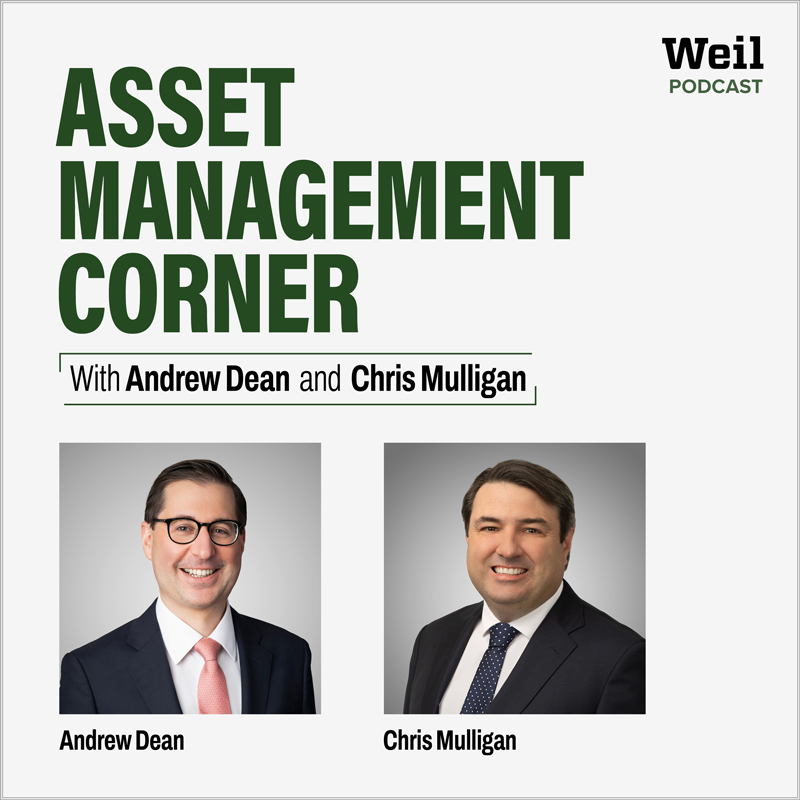
Andrew Dean: Hello and welcome back to Asset Management Corner. We are your hosts, Andrew Dean and Christopher Mulligan, partners at the law firm Weil. This is the podcast where we talk all things SEC regulatory and enforcement. On today's podcast, we're joined by David Woodcock, the Director of Enforcement at the SEC. Chris, our first Director. But first, summer is ending. Any highlights from the summer you can share?
Christopher Mulligan: We had a great summer - a little bit of beaches, a World Cup game - and now we are back at it. With three kids, all of whom are buried in activities, it is full-time carpool duty. Between school, sports, travel teams, you name it, we're all in.
Andrew Dean: I'm in that pain as the kids go back to school and all their activities. We've got travel volleyball, swimming, gymnastics. We also brought our son to school. I will say, he started packing about two hours before we left to bring him to college. I brought him some luggage and other stuff when I was in D.C. for work the week after, so I think he is now set for himself. Chris, turning to business, what do you have for us this week?
Christopher Mulligan: We had a couple of rule proposals and other regulatory developments. First, the Form PF compliance date was extended again - this time to July 1, 2027. This is the most recent of the problematic rules amended during the Gensler era where we have been saying the Commission may rescind or heavily amend the last set of rules and proposals. So far, what we have seen is a series of extensions. Once again, advisers do not need to worry about the prior compliance date taking effect. We are still hoping those amendments are either completely taken away or heavily modified.
Andrew Dean: That is certainly helpful in the near term. What else happened?
Christopher Mulligan: The other big development was the Commission's proposal of Regulation Crypto Assets on August 18. This is not an asset-management rule as such, although there are custody and crypto issues that asset managers face. This proposal is really about offerings of crypto assets and, more specifically, investment contracts involving crypto assets.
Christopher Mulligan: There are three main components. First, a startup exemption that would permit offerings of up to $5 million over a four-year period without Securities Act registration, subject to tailored, principles-based disclosures and the antifraud provisions. Second, a larger fundraising exemption that would permit offerings of up to $75 million in a 12-month period, with more substantial obligations, including financial statements and ongoing reporting. Third, there is a conditional safe harbor designed to address when a crypto asset that was sold as part of an investment contract can effectively become delinked from that investment contract once the issuer's essential managerial efforts have been completed or permanently ceased.
Andrew Dean: That last piece goes directly to the long-running question of how a token can be associated with an investment contract at the capital-raising stage without necessarily being treated as a security forever.
Christopher Mulligan: Exactly. The underlying coin or crypto asset is not necessarily itself a security. The issue is whether it is being offered or sold as part of an investment contract and whether purchasers are relying on the essential managerial efforts of others. The proposal tries to create a workable path for the fundraising stage and then a point at which the asset can stand on its own. It is still only a proposal, and there will be a comment process, so there is a lot of detail to work through.
Andrew Dean: And there is also a durability question. Without legislation, it is not clear how much of the crypto framework can be made permanent from one Commission to the next. We saw that dynamic during the Gensler era, and a future Commission could always take a different view. It is hard to imagine that legislation will not ultimately be important to a durable framework.
Andrew Dean: Let's move to enforcement. One case that caught my eye involved Papamarkou Wellner Asset Management. It is an adviser to high-net-worth individuals, so it is a useful reminder that the same kinds of issues we talk about in private fund cases can arise in the retail or high-net-worth space. The SEC found that the firm's disclosures and advisory agreements said certain referral, solicitation, or placement fees received by an affiliated broker-dealer would be used to offset client advisory fees, but the offsets did not occur as described. The matter was framed as a disclosure and compliance-policy case.
Andrew Dean: To me, the takeaway is straightforward: the SEC is going to keep looking at these cases whether the clients are private funds, high-net-worth individuals, or traditional retail investors. Firms need to make sure their disclosures match what they are actually doing, and that their compliance programs identify and address the conflicts created by fee arrangements.
Christopher Mulligan: I agree. The more complex the arrangement - how revenue is shared, what gets offset, what the thresholds are, what the governing documents require - the more focused the compliance function has to be. These mechanisms can be complicated, and those are exactly the kinds of areas where Exams and Enforcement can identify miscalculations or inconsistencies.
Andrew Dean: The other case worth mentioning briefly is Tricolor. The SEC brought a case in August against former executives of the subprime auto lender, alleging false and misleading representations to investors about the lender's financial health, among other things. There had already been criminal charges brought by the Southern District of New York. Obviously, these remain allegations and there have been no findings in the SEC matter.
Andrew Dean: But it is notable that the SEC brought a complex case that sits alongside a criminal matter. As we move through leadership transitions at the Commission, the fact that David and Osman Nawaz are now leading Enforcement is another signal that the SEC will continue to bring significant, complicated cases alongside criminal authorities where appropriate.
Andrew Dean: All right. We are delighted today to be joined by David Woodcock, Director of Enforcement at the SEC. As I was preparing for the interview, it struck me again that David has had about four careers. He started as an auditor at major accounting firms, went into private practice at major law firms, and from 2011 to 2015 served as Director of the SEC's Fort Worth Regional Office, where he oversaw nearly every major area of the SEC's enforcement and examination programs. He also created and chaired the SEC's cross-office and cross-division Financial Reporting and Audit Task Force. He then spent time as a senior in-house lawyer at ExxonMobil and, most recently, was a partner at Gibson Dunn, where he worked with our good friend Osman Nawaz, who is now David's Principal Deputy Director of Enforcement. David, welcome to the podcast.
David Woodcock: Thank you, Andrew. I'm very happy to be here. I am going to give the disclaimer that I always have to give right now: the views I express are mine and mine alone and are made in my capacity as Director of Enforcement. They may not reflect the views of the Commission, any commissioner, or any other member of the staff.
Andrew Dean: Excellent. David, you have one of the more interesting backgrounds of anyone in the D.C. ecosystem. You have been in and out of the SEC before. How have those experiences shaped the way you are approaching the Enforcement Director role, and what motivated your return to the SEC now?
David Woodcock: I'll take the last question first. What motivated me to return to the SEC is pretty simple: I love the mission of the SEC. I was in the Enforcement Division, and at the Commission, many years ago, and what drew me then and drew me back is the mission. What we do matters - enforcing the securities laws and protecting investors. A lot of organizations have mission statements, but I think the SEC's mission statement is one of the clearest about why we are there. It really does drive the staff, it drives what we do, and it drove me back.
David Woodcock: As for my career, I like to do different things, and I think those different experiences prepared me in different ways. I began my career as an accountant. I probably was not the world's best accountant, but accounting taught me to be careful, to understand the value of numbers, and to understand financial statements and balance sheets. I have always been thankful that I began my career that way.
David Woodcock: I have also always liked being at law firms. I like representing clients and solving problems. And my years in-house were an opportunity I could not pass up; they turned out to be an incredible opportunity to see a lot of exciting things at a great company. Put all of that together and I have been able to see different types of organizations and different kinds of problems from different perspectives. I think that helps me do the job I have today.
Andrew Dean: You have now been back inside the SEC for a few months. Any surprises? How is it going?
David Woodcock: It is going well. One of the things I did when I first got here was visit all of the regional offices and get to know the people there. I think I did that within roughly my first 60 days. That was a lot of travel, especially while maintaining the closed Commission meeting schedule in Washington. Those closed Commission meetings are where we recommend enforcement actions to the commissioners, and they are like a train that runs almost every week. It is almost like having a board meeting every week. I knew it was a big job, but the pace is pretty hectic and there is never much rest. That is fine - I enjoy it.
Christopher Mulligan: Getting out to the regions and seeing the staff is a real boost. Everything we have heard on this side is that people have been excited to have you back at the SEC. What was your message to the staff when you were visiting the regional offices and the home office? How should they be thinking about their day-to-day work?
David Woodcock: The message is very similar to what I said when I took the job. We need to be known for the cases we bring. We need to focus on being as efficient as possible. Time is a limited resource, and we have a clear mission and increasingly clear priorities. We need to execute on that mission because real people rely on us.
David Woodcock: A lot of what I am trying to do is get us back to basics - back to blocking and tackling - and to bring the cases we need to bring as efficiently as possible. We receive an enormous volume of tips, complaints, and referrals. We cannot investigate everything. But we should be efficient not only in bringing cases, but also in investigating matters and closing them when there is nothing there. Just because we open something does not mean it has to become a recommendation to the Commission. We have to be comfortable with that as long as we have an efficient process for evaluating the conduct, deciding whether to move forward, and then moving on when appropriate.
Andrew Dean: That is an important point. People sometimes assume that if Enforcement opens an investigation it must already have concluded that there is a problem.
David Woodcock: You should not expect the staff to be 100 percent convinced about a matter when it opens. We do not know all the facts at that point. That is one of the good things about our process: it is nonpublic, and it allows us to look into an issue and decide whether there is something we should recommend to the Commission or not. We have lawful, nonpublic processes that let us ask for documents and bring people in for testimony. Those are tools we need to use appropriately.
David Woodcock: Where we run into trouble is when people will not let us ask those questions or will not provide the documents we need. I am a strong proponent, when necessary, of using subpoenas and our other investigative tools so that we can understand whether there is a real issue.
David Woodcock: There is also an idea from academic research called the observer effect: simply looking at things has an effect. An investigation is a form of regulatory visibility and a form of messaging to the market. That is one reason it is important for us to move investigations along fairly quickly, aside from statutes of limitation and other practical concerns. We need to be visible. That visibility affects the market. Asking questions, and asking as many good questions as we can efficiently and constructively ask, is a form of regulation even if it does not show up later as a case statistic. That is another reason efficiency is so central to what we are doing.
Christopher Mulligan: That is a great point. The SEC can only open so many enforcement investigations, but the idea that there is a real presence out there matters. We see news reports about SEC exams and investigations in different spaces, and market participants pay attention. They want to understand what the SEC is asking and what the staff is seeing. That has an effect even before there is an enforcement case.
David Woodcock: Right. And that ties into Exams. The Chairman rightly sees Enforcement in the broader context of the SEC's other divisions. The Division of Examinations is a big part of that. There are different ways the Commission can look at an issue. It can come through an examination, which might lead to an enforcement referral and might not. It might lead to recommendations to improve systems and controls and might not. Enforcement is one part of the larger ecosystem of how the SEC regulates, not the only way the SEC regulates.
Christopher Mulligan: And the existence of an enforcement function gives examinations real weight. Most registrants cooperate with Exams and take the process seriously, in part because there is a potential enforcement consequence if serious misconduct is uncovered.
Andrew Dean: Let's turn to asset management, because a lot of our listeners are asset managers. We have seen a number of news reports involving private funds, mismarking, valuation, and related issues. In your first public speech, you devoted a meaningful part of the discussion to private funds and investment advisers. What is the SEC's interest in these topics, and what is your message on private funds?
David Woodcock: Private investment markets are now a vital part of the American financial landscape. I am not sure that was true 50 years ago in the way it is today. The basic message is that Section 206 applies to private securities transactions just as it applies to transactions in public markets. We expect good conduct in private markets just as we expect good conduct in public markets.
David Woodcock: The Chairman has noted in several speeches that the number of public companies has declined over the last several decades, and retail investors have had more limited access to diversified public-market opportunities. At the same time, private credit and private capital have expanded rapidly to meet financing needs. That can be a very good thing, but there are risks in that space that we are attuned to.
David Woodcock: The issues are familiar: liquidity, fees, valuation, conflicts of interest, and related-party relationships. We are looking at conduct not only at the private fund adviser level but throughout the distribution chain. We will pursue matters involving misappropriation of client assets, misleading strategy disclosures, fees and expenses, fraudulent valuations and mismarking, and undisclosed conflicts of interest. Especially with illiquid assets, valuation is incredibly important. We understand that valuation often involves judgment, but the assets still need to be valued properly and the process needs to be real.
Andrew Dean: Valuation is near and dear to your heart as a former accountant. It also intersects with a lot of the things we discuss on this podcast: the private fund adviser rules, how expenses are allocated, how things are distributed, the Custody Rule and audits. Those financial statements end up touching a lot of different hot topics.
David Woodcock: Absolutely. Valuation has been near and dear to me in different ways and different phases of my career. Firms should use third parties where appropriate, make sure they have all the information they should have, and update valuations based on market conditions. Those are basic things that everyone understands, but they can get lost in the heat of the moment.
Andrew Dean: That brings us to something else that is near and dear to your heart. You have created two new initiatives: the Financial Reporting and Accounting Unit and the Retail Fraud Working Group. Can you talk about those groups and what they say about the Commission's priorities?
David Woodcock: They are consistent with the Commission's priorities and with the back-to-basics approach. I will start with the Financial Reporting and Accounting Unit. As a former accountant, this is obviously an area I care about. When I came back to the Commission and met with staff across the offices, I had the sense that we had an opportunity to enhance how we think about financial reporting and to create more consistent coverage in a core area.
David Woodcock: If you go back through the history of the Enforcement Division, financial reporting was always a core part of what the SEC enforcement program did. The Financial Reporting and Accounting Unit is an extension of that current and historical approach to cracking down on bad actors in the accounting and auditing space. The unit is intended to provide dedicated expertise, focus, and capacity to pursue those cases.
David Woodcock: Financial-reporting and accounting cases are among the most challenging, fact-intensive investigations the SEC has. The average time from opening to bringing a case is probably longer than for a typical case. Once you open one, you are making a real commitment to investigate it. By aggregating expertise across the Division, we hope to bring that expertise to bear faster and investigate more efficiently. The SEC has some of the best investigators in the world when it comes to financial reporting. Some of those people will be in the unit and some will remain outside it, but the unit gives the Division a place to concentrate and deploy that expertise. I am excited about that.
Christopher Mulligan: That goes back to your point about efficiency and time being a limited resource. If you have people who have done these cases for years, they know where to look, they know how the accounting works, and they can move more quickly and effectively.
David Woodcock: Exactly. The Retail Fraud Working Group is a different kind of initiative. It is still completely consistent with our priorities. We are talking about Ponzi schemes, offering frauds, and the basic lying, cheating, and stealing that the Chairman has emphasized. What we want to do with the working group is bring focused energy and resources from across the Division to generating cases, building partnerships with regulatory counterparts, and using data and technology to find people who are attacking retail investors.
David Woodcock: That is the primary difference between the two initiatives. The Retail Fraud Working Group is oriented heavily toward case generation and identifying misconduct affecting retail investors. The Financial Reporting and Accounting Unit is a specialized unit designed to bring deep expertise to the investigation and prosecution of financial-reporting, accounting, and auditing cases.
Andrew Dean: You mentioned that financial-reporting cases take longer. One reason we have seen in this Commission is that those cases often include individual accountability. Pursuing individuals can make the cases more complex and take more time. Are we going to continue to see individual accountability in those cases?
David Woodcock: Yes, clearly. Historically, a very high percentage of our financial-reporting cases have involved individuals. I do not have the exact current statistic in front of me, but that has long been true. When you are dealing with a corporation, the people inside the corporation - particularly gatekeepers, accountants, and others who have responsibilities they signed up for - matter.
David Woodcock: There is also a concept that goes back to the Commission's guidance on corporate penalties: when you penalize a corporation, you have to think about who is actually paying that penalty. The more we can identify and charge the individuals responsible for wrongdoing where the evidence supports it, the better the result can be for everyone. We absolutely think about that as we resolve cases.
Andrew Dean: We are also seeing a lot of activity around pre-IPO companies. There was an article in the Journal today about pre-IPO investing, and the SEC has brought cases in that space. A lot of asset managers and retail investors want access to these companies before they go public. It feels like another area where several of the Commission's interests overlap.
David Woodcock: I agree. It brings together a lot of these themes. Retail investors want access to the next hot company before an IPO, and there are people who promise them that access. That creates opportunities for fraud - people advertising shares or interests they do not actually have, misrepresenting what they are selling, or otherwise taking advantage of demand. We have brought cases in that space, and it is an area where retail fraud, private markets, valuation, disclosure, and offering issues can all come together in one place.
Andrew Dean: Finally, let's talk about audit firms. We have seen some restructuring at the PCAOB. What is the interaction like between the SEC and the PCAOB now?
David Woodcock: We have regular interaction with the PCAOB, particularly through the Financial Reporting and Accounting Unit and the Office of the Chief Accountant. We collaborate where appropriate on investigations and have had good conversations with them. Our work is related to what the PCAOB does, although our mandates are not identical. When auditor misconduct is serious and egregious, we will work closely with the PCAOB and with others as appropriate.
Andrew Dean: David, we are wrapping up the podcast and wrapping up the summer. What are you looking forward to in the fall?
David Woodcock: College football season. That is probably the activity that most makes me think of fall - cooler temperatures, Saturday mornings, College GameDay, and watching college football. There is almost nothing I like more. My wife is the same way, so we are looking forward to the first week and, hopefully, a victory for the Tigers.
Christopher Mulligan: That sounds like a good way to spend the fall.
Andrew Dean: David, thank you for coming on. We really appreciate it.
David Woodcock: Thank you, guys. Great to be here.
Andrew Dean: Thank you to David for joining us. That was a great conversation, and thanks to everyone for joining us on Asset Management Corner. Catch you next time.
Disclaimer: The information contained in this podcast is provided for informational purposes only and does not constitute legal advice. Listening to this podcast does not create an attorney-client relationship. You should consult a qualified legal professional with any questions. This podcast may be considered attorney advertising under the laws of certain jurisdictions.

View more about Weil's White Collar, SEC Examinations, Private Funds and Securities Litigation practices.