Season 2, Episode 7: SEC Enforcement Gets Reinforcements, Liquidity Solutions, and World Cup Results
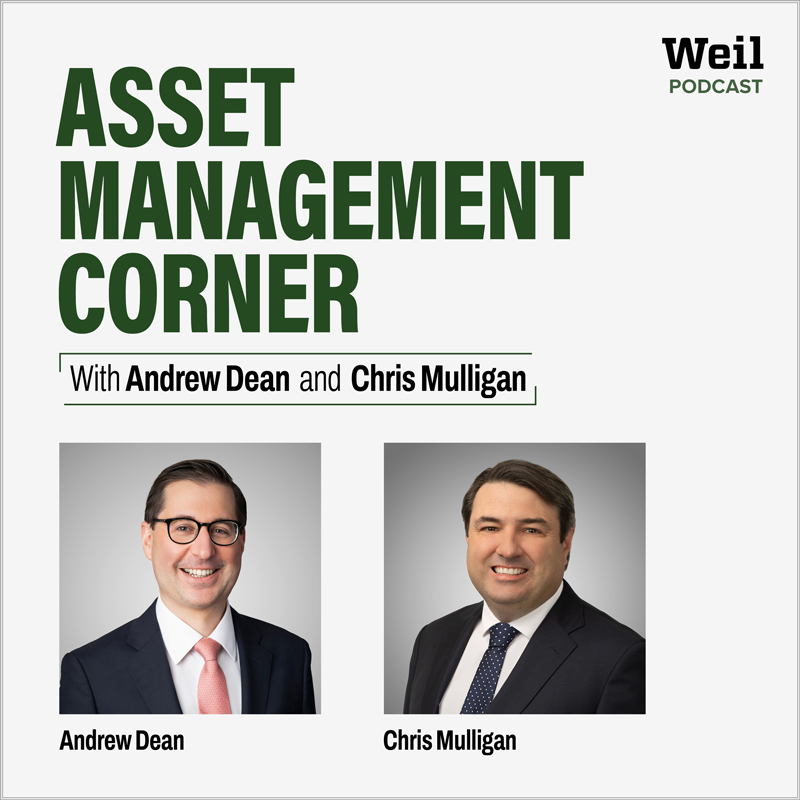
In this episode of Asset Management Corner, Andrew and Chris discuss the SEC's rulemaking agenda, the return of Os Nawaz to the SEC as the new principal Deputy Enforcement Director, and a recent enforcement action involving an ETF. They also take stock of their World Cup predictions. Then they are joined by Danek Freeman, a partner in Weil's Banking and Finance practice where he talks about the fast-moving world of private fund finance, including the increasing use of NAV credit facilities.
Stream here or subscribe on your preferred podcast app:


Transcript
Andrew Dean: Hello, and welcome back to Asset Management Corner. We are your hosts. I’m Andrew Dean; he’s Chris Mulligan. We are partners at the law firm Weil. This is the podcast where we talk all things SEC compliance, enforcement, and examinations. On today’s podcast, we’re joined by Danek Freeman, a partner in Weil’s Banking & Finance practice.
Andrew Dean: But first, Chris, the results are in. The World Cup is over. Chris, who did you pick in the World Cup? You picked the winner.
Christopher Mulligan: I’m an expert in football—not soccer.
Andrew Dean: Soccer, Chris.
Christopher Mulligan: Right. So, obviously, I know more about soccer than you and most other people here. I picked the number-one-ranked team in the world.
Andrew Dean: Obviously, it didn’t go well. The underdog—yeah. I feel that we had our friend Adam on earlier this season. His English team had a rough loss, and our friends also had a tough loss. I think the U.S. team did a nice job, started in a very dominant fashion. Rough to see them go out when they did and how they did, but it was fun all around. Chris, fun all around. We get to do it again.
Christopher Mulligan: Yeah. I went to a game in Kansas City. I saw Ghana versus Colombia, and it was basically 99 percent Colombia fans. It was a really, really great experience.
Andrew Dean: Awesome. But we’ll wait at least another 12 years until it gets back to the U.S. We’ll get on to more mundane things.
Andrew Dean: Chris, earlier this month, the SEC put out its new rulemaking agenda. What can you tell us?
Christopher Mulligan: Yeah. So this is the newest SEC regulatory flexibility agenda. This is designed to inform the public what rules they are working on. I should start by saying this has a tenuous connection to reality—to what actually happens. And that’s not just this administration; that’s every administration.
Christopher Mulligan: It’s usually a very long list, a very ambitious list of rules, and usually a very small subset of rules even get proposed, and an even smaller subset actually makes it across the finish line and becomes final rules.
Christopher Mulligan: Look, it’s helpful. It provides a window into what the SEC rulemaking divisions are working on, and it certainly provides themes of things they’re working on.
Christopher Mulligan: I think there are pretty clear themes here. Crypto is obviously a very big priority. They’re working on a comprehensive regulatory framework for crypto assets and tokenized securities. They want to clarify market structure, broker-dealer rules for digital assets, and they really want to end regulation by enforcement with formal rulemaking.
Christopher Mulligan: There’s capital formation, IPO reform. It has received a lot of attention. We’re not going to spend a lot of time on that, but obviously they’re trying to make it easier for a company to go public. Again, that impacts some of our audience in the private equity space that utilize the public markets to exit portfolio companies.
Christopher Mulligan: There are corporate disclosure changes that reduce some of the disclosure requirements around climate-related disclosures, executive compensation, and other topics.
Christopher Mulligan: I think the topics most important to our listeners are the rules that are going to directly, perhaps, impact advisers and registered investment companies. They’re revisiting, of course, Form PF reporting—we have some of those rules here—but they’re also going to look at more important requirements: books and records for registered investment advisers, a very, very important rule.
Christopher Mulligan: They’re going to really revise Rule 15c2-11—retail access to private investment funds—and continue to revisit the accredited investor rule, which has been tried a couple of times. We’ll see if we get some changes this time around.
Christopher Mulligan: So, look, we talk about this a lot. This is a deregulatory agenda. Deregulation takes regulation. You can’t just wave a magic wand and make rules go away. There’s a process for it. It’s a very time-consuming process. You have to justify every single thing you do.
Christopher Mulligan: So, in its way, this is an incredibly ambitious agenda, and it’ll be perhaps an exciting few months—or year—as we begin to see proposals come out, then the comment period, and then, as they make their way to final rules, we could see some pretty significant changes if even a fraction of these ideas get across the finish line and actually become rules.
Andrew Dean: Yeah. I’ll be interested to see, Chris, what this Commission is able to do over the coming couple of years. There’s not a lot of time to get some of these rules moved forward and pushed through, so we’ll see what they can do.
Andrew Dean: On the enforcement front, just a couple of things to touch on.
Andrew Dean: First up is: three weeks ago, David Woodcock, the Director of Enforcement, announced on LinkedIn that Osman Nawaz is returning to the SEC to be Deputy Director of Enforcement. It’s since been made clear that he is now the Principal Deputy Enforcement Director.
Andrew Dean: During his prior SEC stint, Osman was in the middle of some of the most complex and consequential enforcement actions. He ran the CFI Unit—the Complex Financial Instruments Unit—at the same time, Chris, that I was in the Asset Management Unit. We worked on a lot of cases in parallel together.
Andrew Dean: I think this is yet another—in addition to the appointment of David—a clear indication that Enforcement is still serious, is still going to bring real, consequential cases, as we’ve seen coming out of the SEC, and we see support from commissioners for those actions.
Andrew Dean: In terms, Chris, of enforcement actions, there is one that I want to mention that just came out yesterday. And I will admit, in the category of TMI, I was coming out from under anesthesia at the time from a medical procedure, and the first thing I saw in my LinkedIn feed, Chris, was an announcement of a matter involving an ETF for prohibited transactions, risk reporting, and disclosure violations.
Andrew Dean: It is the first action involving the Investment Company Act’s Rule 18f-4 provision, which is exceeding leverage thresholds by an ETF. Chris, I think it’s consequential. It’s important because ETFs right now are a big focus. It’s fundamentally a retail product, and this Commission, early on, has said that they would continue looking at retail issues and they would look out for complex products—whether or not there’s too much leverage.
Andrew Dean: We see that a reporting threshold was not met and was exceeded; the cap that the fund had on it; and there was delay in reporting. So those are real ’40 Act issues that this Commission is going to continue to pay attention to.
Andrew Dean: As we’ve always said, two of three commissioners spent time in the Division of Investment Management, cared deeply about and understand deeply the issues around ’40 Act products, so I think we will continue to see attention paid in that space.
Andrew Dean: I think consistent with all that is the announcement earlier in July that the SEC was putting together a new Retail Fraud Working Group. Under the Clayton Commission, that was called the Retail Strategy Task Force. That work continued through the Gensler Commission and eventually dissolved. But, as a general matter, the SEC has always cared significantly about retail investors and retail harm.
Andrew Dean: I think the creation of this group emphasizes that interest under this Commission as well. There have been various announcements: Kate Zoladz, Deputy Director in the western part of the SEC, and Kim Frederick from the Asset Management Unit will be leading it.
Andrew Dean: Obviously, investment advisers are oftentimes at the heart of retail-fraud issues and questions, so that’s a smart team that’s going to tackle those issues. We’ll continue to watch for their work and efforts in the years to come.
Andrew Dean: Now for the interview portion of our show.
Andrew Dean: Anyone interested in our work knows that we talk a lot about the liquidity needs of private equity fund advisers on this podcast. There is great desire for private equity fund advisers to get capital back to their investors. Liquidity is a metric that investors weigh.
Andrew Dean: This is why we’re seeing an explosion in the fund finance space. Fortunately, today we have our guest Danek Freeman, who coordinates Weil’s Fund Finance practice, to talk with us about the increasing use of NAV facilities and other alternatives to selling a portfolio company to create liquidity for your investors.
Andrew Dean: We’re happy to have Danek here, out of Weil’s New York office. He represents asset managers and investment firms in a variety of financing transactions, including subscription lines, NAV facilities, margin lending, as well as clients in acquisition financing, syndicated and direct lending transactions, and distressed-debt and restructuring matters. So he’s easily the perfect person to talk with us about what’s going on right now in the fund-liquidity space.
Andrew Dean: Danek, thanks so much for taking time out of your busy schedule to join us.
Danek Freeman: Thank you. Happy to be here.
Andrew Dean: Let’s start with the most basic question, obviously. A private equity fund can sell a portfolio company. That is one option to achieve liquidity. But what are some alternatives that you’re seeing private equity funds use besides selling a portfolio company to achieve fund-level liquidity?
Danek Freeman: Yeah, there’s a number of options. For a PE fund, the traditional exit, as you say, is a sale to a third party, which might also take the form of a sale into the public markets—what people call an IPO. That’s really, essentially, also selling ultimately into another party.
Danek Freeman: When those markets are either closed or not available at the right price, people look for other alternatives.
Danek Freeman: The most common alternatives currently are secondary transactions, which allow LPs to sell fund interests to new holders. They could be strip sales, which involve multiple funds. And second, continuation vehicles, that allow the GP to sell investments to a new fund or vehicle and allow the existing LPs to roll over or exit those investments at that time.
Andrew Dean: So you’re talking about the LPs can sell their interests in the fund to third parties; and then, also, sometimes the adviser—the underlying asset—that’s the sort of GP-led secondary, the sale of the underlying asset to another vehicle that the adviser controls. Those are two options that you’re referring to?
Danek Freeman: In the market, those are generally called secondary transactions, and ultimately an indirect sale, right? This is another form of a sale. Ultimately, an equity risk holder is changing in those transactions.
Danek Freeman: Those are the most common, also called “alternatives.” They’re becoming more common, so maybe they’re emerging as just another option alongside the traditional M&A and IPO exits.
Danek Freeman: The third option is asset-based lending, called NAVs—sometimes called back leverage. This allows the fund to borrow against the value of the investments and use the proceeds to fund distributions or increase portfolio size.
Danek Freeman: Asset-based liquidity is fundamentally different because it’s actually just creating liquidity. It’s not really an exit, but it’s ultimately monetizing the assets through a two-step process: first, you do leverage, and ultimately dispose of those assets at a later time.
Danek Freeman: So those are the three big alternatives: an LP secondary, a continuation vehicle, or a NAV facility. Those are now increasingly on the menu for any fund manager in terms of exit options.
Christopher Mulligan: And so, a NAV facility—I think most of your audience understands—but a NAV facility is different than a subscription line of credit, because a subscription line of credit is secured by the commitments of the LPs in a fund, versus a NAV facility which, as you said, is actually secured by the underlying portfolio companies. Is that right?
Danek Freeman: Yeah. NAVs differ primarily in two ways from traditional subscription facilities.
Danek Freeman: First, the credit is extended based on the value of the portfolio. You may or may not have direct security in those investments, as a structural point.
Danek Freeman: The other fundamental difference is that they’re typically designed to provide liquidity for either additional investments or distributions, whereas the subscription line is traditionally designed to provide working capital—what you call working capital—to bridge and regularize capital calls, maybe fund expenses, sort of the day-to-day life of the fund. It’s not really designed to provide permanent leverage or liquidity to the investors.
Danek Freeman: So they’re different both in the way they’re structured and underwritten and, second, in the use cases. That said, as the market evolves, there’s a lot of mixing and matching of these concepts, both structurally and in the use of proceeds. Those distinctions don’t always hold true as people become more creative with products.
Andrew Dean: Interesting. So can you combine a subscription line with a NAV facility?
Danek Freeman: In certain instances. These are often called hybrids.
Danek Freeman: Initially, they were conceived as having a subscription line early in the investment cycle, when you have a lot of capital commitments. Then, as those capital commitments are gone and the portfolio is funded and invested, the asset base shifts to the value of assets, and the facility shifts to being underwritten and structured around the investment collateral.
Danek Freeman: Sometimes they’re contained in the same agreement, creating sort of a cradle-to-grave financing structure. Sometimes they’re done separately.
Danek Freeman: Sometimes, when there are more complicated use cases—for example, bridging regulatory or tax issues, or just other ways capital either needs to be allocated or contributed—people borrow bits and pieces of these structures to create bespoke facilities, to find the most efficient, cost-effective way to put the capital into the vehicle.
Andrew Dean: So what is the typical use case for a NAV facility? Is it to get liquidity back to investors? Is that the primary reason?
Danek Freeman: The use cases are really twofold: it’s either to increase investment or increase distributions.
Danek Freeman: In PE funds, distributions are relatively rare. In investment funds, they can be more common in terms of pro rata distributions or in kind. But that would be the other primary use case.
Danek Freeman: There are really two aspects to think about when you think about a NAV. One is the use of proceeds: would it be distributions? Is it going to be investments?
Danek Freeman: The other is also the financial impact of the leverage, and how you are utilizing that strategically and tactically.
Danek Freeman: The most common use for a NAV for a PE fund is to fund new investments—to do follow-on investments. That could mean an acquisition by a portfolio company, to refinance portfolio company debt, provide rescue capital to a distressed portfolio company, to just fund operating needs and capital needs, or to bridge an ultimate exit.
Danek Freeman: There are unlimited variations when we say “fund investments.” Some of those can be accretive and positive. Others can be defensive, to protect the portfolio depending on the situation.
Danek Freeman: So even within the concept of investments, there are a lot of different variations that people, including investors, can take different views on. Are you throwing good money after bad? Is this a good opportunity? Should you be doing this after the investment cycle?
Danek Freeman: It’s not as simple as, “Oh, it’s good; it’s investments,” or, “It’s a distribution.” Within the universe of investments, there are also some questions and considerations for investors.
Andrew Dean: To your point about underwriting: under a traditional private equity fund, when a portfolio company itself is borrowing money, that borrowing is all happening at a portfolio company. One portfolio company is securing its own.
Andrew Dean: Obviously, subscription lines of credit involve a pledge of the LP interests to secure the subscription line of credit. Since this is a mix of assets, can you walk us through what the underwriting process is like for a NAV facility? How are they looking at all these different assets? How does it work?
Danek Freeman: So how does a lender look at a subscription line? The lender in a subscription line is looking at the investors and their unfunded capital commitments. Ultimately, when the LPs have to pay back, the question is: what’s the creditworthiness and the ability for that LP to fund the capital commitment, and their willingness?
Danek Freeman: So that analysis centers on the creditworthiness and the ratings of investors, and the dynamic with the fund and investors. It doesn’t really look at the value of the fund.
Danek Freeman: When you move to a NAV facility or any asset-based facility, the debt is based on the investment. So the focus becomes not who the investors are, but what the quality of the assets underneath in the portfolio are, because that’s ultimately where the recourse is for value.
Danek Freeman: Not just, “Is there enough value here to buy the loan?” but, “Will there be enough value to recover the loan?”
Danek Freeman: In the subscription line, the lenders will go after the unfunded commitments, so they’re facing the investors, not the assets. With the NAV, they’re going to go after the fund assets and the NAV.
Danek Freeman: So diligence accordingly focuses on the underlying investments. And it’s not so simple as: the investment is good. There are several dimensions to that.
Danek Freeman: First: is there a critical mass of investments? The thesis of most NAV and portfolio company underwriting is that there’s diversification. That’s why it’s often cost-effective in general, because that addresses a lot of the credit risk in terms of the diversity of assets. You need a critical mass of assets. Obviously, the more the better.
Danek Freeman: Then, depending on the portfolio, manager, or fund, you might require more or less direct security. That often, in real life, depends on what is possible under the underlying investments and the structure and the tax issues around the fund.
Danek Freeman: Ultimately, the lender will start with: “One, I want to get direct security in everything I can.” Then you sort of back away from that and ask what’s possible in any given situation.
Danek Freeman: So that’s the thesis of underwriting: I’m going to be able to get these assets and monetize them directly, either through direct security or structurally.
Andrew Dean: So the result of that is that the NAV lender has priority over all the investors in terms of their claims. And the GP to the fund also has to perform diligence on its underlying assets, I assume. Danek, can you walk us through that process and who’s involved in it?
Danek Freeman: Right. That is something that’s often overlooked and not appreciated at the outset.
Danek Freeman: While the lenders are doing their diligence—or even before the lenders start kicking the tires—a fund itself and the GP need to do the diligence to see to what extent they can do a NAV, and to what extent there may be limitations on the structure.
Danek Freeman: This requires a host of disclosure, governance, tax, and regulatory aspects, all of which require internal specialists.
Danek Freeman: It’s the empty bed around which we structure the facility, and often things need to be tailored around some of the issues which are very specific in each case.
Danek Freeman: At the outset, in addition to lender diligence, there is what we call the “fund diligence” to see what are the parameters for putting leverage into any particular fund structure.
Christopher Mulligan: What’s the current landscape? What’s the competitive landscape? Are there a lot of lenders chasing these opportunities? Are interest rates high? What’s the landscape right now in terms of this area currently, both the subscription-line and NAV world?
Danek Freeman: I will say that there’s a lot of competition and a lot of new capital. I think I read somewhere that, over the last couple of years, in terms of credit, it’s the biggest-growing asset class itself, because credit funds are providing the NAVs.
Danek Freeman: So the result is a very competitive environment for lenders, which is great for fund borrowers and GPs.
Danek Freeman: The result of that is you can get good terms, good cost of capital relative to the interest environment that we’re in and, more critically, a real light touch with respect to structure and security—especially on the latter conversation.
Danek Freeman: Because in the competitive process, often lenders will forgo direct security in the investments. They may be structurally subordinated anyway, but all those conversations have become increasingly easier over the last year or so as more entrants have come into the market, and people become more sophisticated about the product and realize there are some credit limits on the direct recourse. They find different structures where they can get comfortable.
Danek Freeman: All of this is to the benefit of the fund and borrowers—again, if they play it right.
Danek Freeman: The key thing for most fund borrowers is to run a competitive process right up front and put everything out on the table on these key terms, and make sure that you can get a good competitive bid and a workable structure for your fund up front—and not find out later on in the process that there’s an issue.
Andrew Dean: This area has just exploded and changed so much. I remember first hearing about NAV facilities when I was at the SEC. We were all curious what these things were, right?
Andrew Dean: I mean, I knew subscription lines of credit. I was an associate working on pledge agreements. They’ve been around a while. But NAV facilities existed, and the explosion in secondaries has happened in the past few years.
Andrew Dean: It seems to be a fast-moving area that is just full of innovation. Where do you think this is headed? You mentioned hybrids between subscription lines and NAV facilities. NAVs are out there. Where do you think this is all headed over the next five to ten years in terms of liquidity options for private equity fund advisers?
Danek Freeman: Yeah, I think the headline there really is that whereas, when you were at the SEC a few years ago, NAVs were episodic and were a new thing, and people were getting their heads around the issues around their structures and the use of proceeds.
Danek Freeman: Over the last couple of years, there has been a real normalization in the PE fund space on the use of NAVs, in the same way that secondary transactions are becoming more normalized, a more regular part of the landscape. And investors are becoming more comfortable with their structures.
Danek Freeman: I think if you look out five years, if the investment cycle is longer or has become a permanent feature in the capital markets, I think that NAVs, along with secondary transactions, are going to become more of a standard feature.
Danek Freeman: The product will become more standardized—rules on the structure and other elements—and this will be the maturing of the NAV loan, not necessarily a newfangled product in that area.
Danek Freeman: It just checks so many boxes with respect to what you can do as a fund manager, in terms of the different use cases for it, the different benefits. And as the investor community has gotten more comfortable with it, with the help of industry guidelines and by pre-wiring it in governance documents, there is just going to be greater acceptance and greater utility to have the option to do that facility, especially as investment cycles ebb and flow.
Andrew Dean: Danek, really fascinating stuff. Very interesting space. We know the regulators are watching this area very closely. We know many of our clients are obviously very interested, and investors are interested in these options. It’s just a fascinating area.
Andrew Dean: Thank you so much, Danek, for coming on and spending some time chatting with us and informing us about these really important issues.
Danek Freeman: Happy to be here.
Christopher Mulligan: Thanks.
Andrew Dean: Thanks for joining us, everyone. We’ll catch you next time on the next episode of Asset Management Corner.
Disclaimer: The information contained in this podcast is provided for informational purposes only and does not constitute legal advice. Listening to this podcast does not create an attorney-client relationship. Please consult a qualified legal professional if you have any questions. This podcast may be considered attorney advertising under the laws of certain jurisdictions.

View more about Weil's White Collar, SEC Examinations, Private Funds and Securities Litigation practices.