Season 2, Episode 6: The Feds Are Here: DOJ Interest in Prediction Markets and Valuation Concerns. (And Knicks Talk)
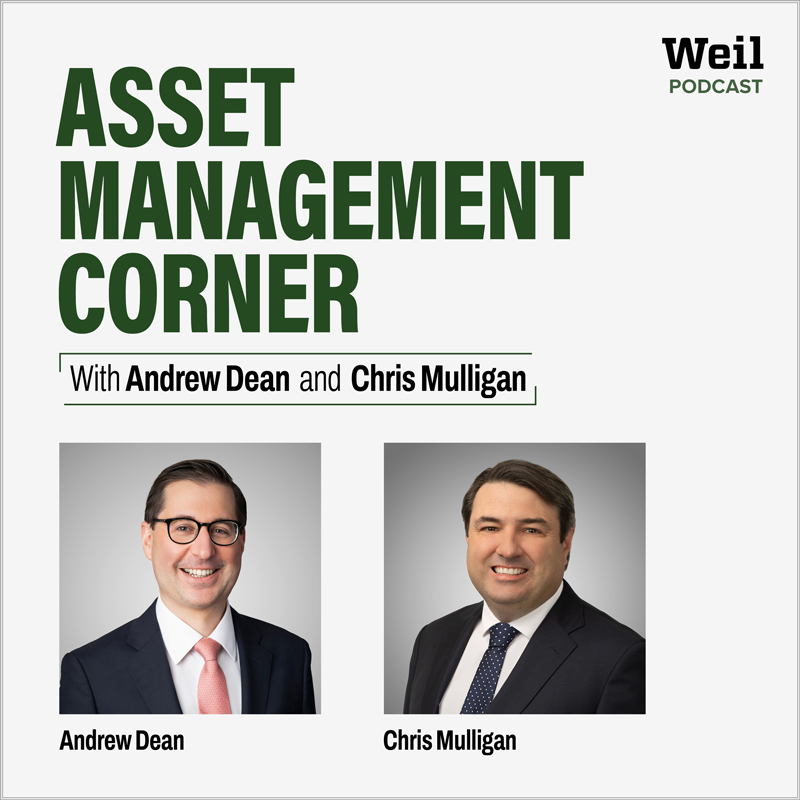
In this episode of Asset Management Corner, Andrew and Chris discuss two recent Supreme Court cases, Exam’s risk alert involving economic conflicts of interest, the new Enforcement Director’s first speech, and the first charges by this Commission of the whistleblower protection rule (Rule 21F-17). They are then joined by their first government guest: Andrew Thomas, Co-Chief of the Securities and Commodities Fraud Task Force at the United States Attorney's Office for the SDNY. Andrew T. talks about enforcement in the prediction market space, the SDNY’s interest in private fund valuations, the DOJ’s cooperation and self-disclosure program, and the state of parallel investigations with the SEC. Then they talk Knicks basketball.
Stream here or subscribe on your preferred podcast app:


Transcript
Andrew Dean: Hello and welcome back to Asset Management Corner. We are your hosts, Andrew Dean and Chris Mulligan, partners at the law firm Weil. This is the podcast where we talk all things SEC compliance and enforcement. On today's podcast, we're joined by Andrew Thomas, who is the Co-Chief of the Securities and Commodities Fraud Task Force at the U.S. Attorney's Office for the Southern District of New York.
Andrew Dean: But first up, Chris, we've got two important Supreme Court cases to discuss since our last podcast. First, on June 4, the U.S. Supreme Court ruled that the SEC could continue collecting disgorgement — meaning ill-gotten gains of alleged fraudsters — without having to identify victims.
This was a leftover question stemming from the Supreme Court's reasoning in Liu. There are still open questions about disgorgement, including what happens if money goes to the Treasury or if it's deemed infeasible to return funds to investors. Those questions remain for another day. For now, disgorgement remains a viable SEC remedy.
There was also another Supreme Court decision involving the Investment Company Act. Chris, why don't you take us through that one?
Chris Mulligan: This decision came out on June 11. In FS Credit Opportunities Corp. v. Saba Capital, the Supreme Court ruled that Section 47(b) of the Investment Company Act does not create an implied private right of action allowing investors to sue for rescission of contracts that allegedly violate the Investment Company Act.
For several years there had been a split among the circuits. The Second Circuit had allowed plaintiffs to rely on Section 47(b) as a vehicle to challenge Investment Company Act violations and seek rescission, while other circuits had rejected that approach.
In a 6–3 decision authored by Justice Barrett, the Court held that Section 47(b) is remedial rather than rights-creating. As a result, courts cannot infer a private right of action under that provision.
The Court emphasized that Congress must expressly create private rights of action. The Investment Company Act gives the SEC primary enforcement authority, and where Congress intended private rights of action elsewhere in the statute, it said so explicitly.
The practical takeaway is that there is no standalone Section 47(b) rescission claim. The SEC remains the primary enforcer of the Investment Company Act, and this decision will significantly impact private litigation involving mutual funds and other registered investment companies.
Andrew Dean: What I’m curious about is whether the SEC becomes more active in this area going forward. Historically, the SEC may have stepped back when private litigants had an avenue to seek relief. Now that this avenue is closed, it will be interesting to see whether future Commissions become more aggressive in bringing cases involving issues like control-share provisions and other Investment Company Act matters.
Saba has already indicated it intends to pursue alternative legal theories, so there’s certainly more to come on this story.
Chris, we recently received an examination risk alert, and we’re also heading into the SEC’s fiscal year-end. Tell us about the risk alert and what registrants should expect over the summer.
Chris Mulligan: On June 9, the Division of Examinations issued a risk alert titled “Examination Observations of Investment Adviser Obligations Related to Economic Conflicts of Interest.”
I often caution people against reading too much into risk alerts as direct reflections of a Commission’s current priorities because risk alerts take a long time to produce. Examiners have to review thousands of deficiencies, categorize them, and identify trends.
That said, whether by design or coincidence, this risk alert perfectly reflects what we’re seeing in examinations right now. These are exactly the types of issues this Commission and the Enforcement Division appear focused on — conflicts of interest that directly cost investors money.
The alert focused on several areas. First, cash management and cash sweep programs. Examiners observed advisers failing to fully disclose conflicts arising from sweep arrangements, including revenue-sharing agreements with custodians and broker-dealers, incentives to recommend higher-compensation sweep vehicles, charging advisory fees on cash balances, and recommending higher-cost money market funds when lower-cost alternatives existed.
Second, misleading conflicts disclosures. The SEC continues to focus on the word “may.” If a conflict actually exists, firms cannot simply say a conflict “may” exist. This has been a recurring theme in risk alerts, Form ADV instructions, and enforcement actions for years.
Third, mutual fund share-class selection. This remains an evergreen issue. Examiners continue to identify situations where advisers recommend share classes that generate revenue-sharing or other compensation benefits for the adviser or its affiliates.
Fourth, fee-billing deficiencies. This remains perhaps the single most significant issue we’re seeing. Examiners are intensely focused on management fee calculations across all adviser types — private equity, hedge funds, retail advisers, real estate advisers, and others.
They’re comparing fees charged against advisory agreements, Form ADV disclosures, and internal policies and procedures. Any inconsistency is receiving significant attention.
Andrew Dean: What are examiners focused on as we head into the SEC’s September 30 fiscal year-end?
Chris Mulligan: This is actually a strange period for registrants. We’re not seeing many new exams open because examiners are focused on closing existing exams before September 30.
That can create long periods of silence for firms currently under examination. Sometimes that means the staff is confident they can finish later. Other times it means they’re consulting with policy divisions or Enforcement regarding potential outcomes.
Examiners are laser-focused on whether they can close a matter before fiscal year-end. If they don’t think they can, the exam may effectively move to the back burner until after September 30.
The summer also brings vacations and staffing fluctuations on both sides, which contributes to a less predictable cadence than what we typically see during the fall and winter.
Andrew Dean: On the enforcement front, the day we released our last podcast was the same day new Enforcement Director David Woodcock delivered his first public speech.
Three themes stood out. First, Chairman Atkins’ “back to basics” message. Second, support for SEC staff. Third, a significant focus on investment advisers and private funds.
What struck me most was that among all the substantive topics discussed, the largest section of the speech focused on private funds. Director Woodcock specifically highlighted liquidity, fees, valuations, conflicts of interest, safeguarding client assets, misleading disclosures, valuation issues, mismarking, prohibited trading practices, and undisclosed conflicts.
Chris, this aligns with what we’ve been discussing for months. While there was initially a perception that this Commission might focus more heavily on retail issues, we continue to see significant attention devoted to private funds.
We also saw the first whistleblower-protection case under this Commission involving Rule 21F-17.
Rule 21F-17 prohibits actions that impede individuals from communicating directly with the SEC about possible securities law violations, including enforcing confidentiality agreements that discourage whistleblowing.
Historically, these cases focused on employment agreements. Over time, the SEC expanded its focus to include confidentiality agreements with investors, settlement agreements, consulting agreements, policies, training materials, and virtually any other agreement that could discourage SEC reporting.
The SEC has identified a variety of problematic provisions, including requirements that individuals confirm they have not communicated with the SEC, waivers of whistleblower awards, obligations to notify the company before contacting regulators, and certifications that no complaint has been filed.
Chris, what are you seeing in exams on this issue?
Chris Mulligan: This is an easy issue for examiners to identify. They review confidentiality provisions and look for an appropriate whistleblower carveout.
We haven’t seen a massive increase in focus compared to fee and expense issues, but examiners continue to cite it regularly because it’s easy to spot and easy to test.
That’s what makes it dangerous. A deficiency is often identified simply by reading the agreement.
Andrew Dean: It’s also easy to imagine whistleblower attorneys identifying these issues during the course of representing a client and bringing them to the SEC’s attention.
Now let’s move to today’s interview.
We’re joined by Andrew Thomas, Co-Chief of the Securities and Commodities Fraud Task Force at the U.S. Attorney’s Office for the Southern District of New York.
When I was at the SEC, Andrew and I worked together on a number of parallel investigations, including Archegos, which Andrew tried to conviction in what became the largest market manipulation case ever prosecuted.
Andrew, welcome to Asset Management Corner.
Andrew Thomas: Good morning. Great to be here. Thank you for having me.
Andrew Dean: Let’s start with prediction markets. We’ve seen recent cases involving prediction-market trading, including allegations involving a U.S. Army soldier and a corporate employee who allegedly used nonpublic information to place wagers.
Why the focus? Is this an area where we should expect continued attention from the Southern District?
Andrew Thomas: I think it’s important to put prediction markets into context.
Historically, SDNY has been a leader in enforcing insider trading and fraud laws. From our perspective, the market being used to monetize information doesn’t fundamentally change the analysis.
Whether it’s equities, options, commodities, crypto, or prediction markets, we’re focused on fraud and misuse of information.
Prediction markets have generated a great deal of attention recently, but by dollar volume they remain much smaller than traditional markets.
That said, where we see national security implications or significant harm to investors or companies, we’re absolutely prepared to use our enforcement tools in this space.
Andrew Dean: It seems like deterrence itself is an important goal here. If prediction markets are going to become mainstream, market participants need confidence that insider trading won’t be tolerated.
Andrew Thomas: Absolutely. Our view is that a little deterrence can go a long way. These cases send the message that fraud is fraud regardless of the platform where it occurs.
Andrew Dean: Another major topic right now is private credit.
We’ve seen public reporting around investigations in this area, and U.S. Attorney Jay Clayton has spoken about valuation concerns. What can you tell us about SDNY’s interest in private credit?
Andrew Thomas: Our interest is high.
Private markets increasingly resemble public markets in terms of capital formation and investor participation. But unlike public markets, private markets often involve less transparency.
That creates opportunities for fraud. We’re interested not only in borrower misconduct, but also in communications with investors, valuation practices, and marking issues.
These are complicated products with legitimate economic benefits. But there’s also an important role for law enforcement in ensuring that investors receive accurate information.
Chris Mulligan: From the SEC side, we’re seeing valuation receive tremendous attention in examinations.
Examiners are no longer simply checking whether firms have valuation committee meetings. They’re digging into methodologies, assumptions, comparable company analyses, discount rates, projected cash flows, and consistency across products.
They’re also examining the interaction between valuation and conflicts of interest — particularly where valuations affect management fees, carried interest, subscriptions, redemptions, or marketing efforts.
Andrew Dean: One thing we often hear from clients is concern that regulators may simply second-guess good-faith valuation judgments. How should firms think about that from a criminal perspective?
Andrew Thomas: The core elements of criminal fraud are willfulness and intent to deceive.
We are not a regulator. We’re not interested in whether a business decision could have been slightly better or whether a valuation model could have been marginally improved.
What matters to us is whether someone intentionally misled investors.
Inconsistent methodologies can sometimes reflect poor business judgment. Other times they may reflect an effort to achieve a desired outcome — preserving a valuation, avoiding redemptions, generating fees, or attracting investors.
That’s where our interest lies.
Andrew Dean: Another important topic is SDNY’s self-reporting initiative. The Southern District has been a leader in encouraging self-reporting. Tell us about the program.
Andrew Thomas: The goal is to align incentives.
Historically, companies often hesitated to self-report because the process was uncertain. They didn’t know how long it would take or what outcome they would receive.
Our new policy is designed to provide predictability. Qualifying companies can receive a conditional declination within weeks of self-reporting. If they cooperate and remediate appropriately, they can receive a final declination.
There are no fines, no forfeiture, no deferred prosecution agreements, no monitors, and no lengthy negotiations over statements of fact.
The goal is to make victims whole, obtain cooperation, and hold individuals accountable while rewarding responsible corporate behavior.
Andrew Dean: How will people know whether the program is working?
Andrew Thomas: We’ve already announced one matter that originated through a self-report, resulting in charges against three individuals.
This year we’ve already received significantly more self-reports than we received during all of last year. Our expectation is that the results will become increasingly visible as these cases develop.
Andrew Dean: One final substantive topic: parallel investigations.
When I was at the SEC, some of the most consequential cases I worked on involved parallel investigations with SDNY. What is the current state of that relationship?
Andrew Thomas: The SEC remains one of our strongest partners.
The SEC brings unique expertise and investigative tools that materially enhance criminal investigations. We had a strong relationship with former Enforcement Director Judge Ryan, and we look forward to working with Director Woodcock as well.
I think reports about the death of parallel investigations are overstated. There may be circumstances where criminal investigations move faster because of concerns like flight risk or immediate investor harm, but the SEC remains very active and continues to contribute substantial value to these investigations.
Andrew Dean: Last topic: the Knicks just won their first championship in 53 years. How has that been received in the Thomas household?
Andrew Thomas: Very positively.
My nine-year-old daughter became completely invested during this playoff run. She’s covered our apartment with hand-drawn “Go Knicks” signs.
Even though my kids had to go to bed before the end of the Finals, the first thing they wanted to do the next morning was watch the replay from beginning to end.
My six-year-old was convinced they weren’t going to come back in the third quarter, but thankfully everything worked out.
Andrew Dean: I thought the mayor had canceled bedtime for Knicks fans.
Andrew Thomas: There are still consequences to keeping a six-year-old up all night, but they certainly got to participate through all the celebration happening outside.
Andrew Dean: Chris, what’s the rest of the country’s reaction to the Knicks winning?
Chris Mulligan: We’re happy for New York. Madison Square Garden is a great place to watch a game.
But down here in Washington, we’re focused on the NBA Draft and the Wizards having the number one pick. Hopefully we’ll get our own superstar and make a Finals run someday.
Andrew Dean: Fair enough. As a Knicks fan, it’s been a very long journey. A lot of highs and plenty of lows. This championship was pretty special for New Yorkers.
Andrew, thanks so much for joining us. And thank you to everyone listening. Please join us next time for Asset Management Corner.
Disclaimer: The information contained in this podcast is provided for informational purposes only and does not constitute legal advice. Listening to this podcast does not create an attorney-client relationship. You should consult a qualified legal professional with any questions. This podcast may be considered attorney advertising under the law of certain jurisdictions.

View more about Weil's White Collar, SEC Examinations, Private Funds and Securities Litigation practices.