Season 2, Episode 5: Place Your Bets: Prediction Markets Go Mainstream and Form PF Changes
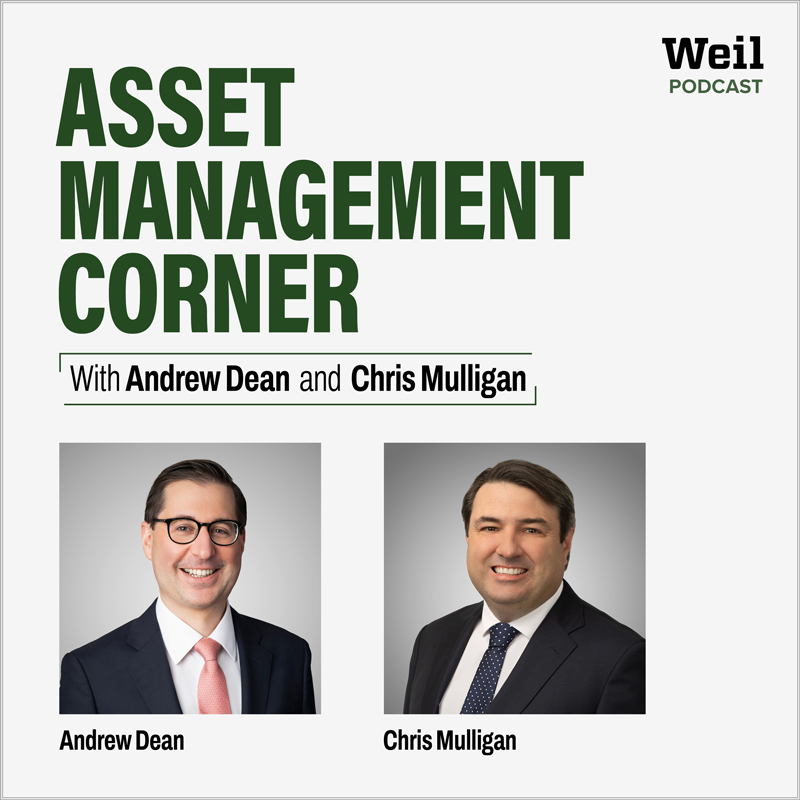
In this episode of Asset Management Corner, Andrew and Chris share additional observations on the proposed Form PF amendments, discuss the recent arrest of a U.S. soldier accused of “insider trading” tied to the removal of a foreign head of state, and explore how advisers should address prediction markets in their compliance programs. They are then joined by Maryellen Maurer, Managing Director at Standish Management and former member of the SEC Division of Examinations’ Private Funds Unit. Maryellen reflects on her experiences as an in-house compliance officer, compliance consultant, and regulator, and discusses current trends she is seeing in SEC examinations of advisers. They wrap up with summer travel plans, including Maine, lobster rolls, Mount Rushmore, the Outer Banks, and avoiding hantavirus.
Stream here or subscribe on your preferred podcast app:


Transcript
Andrew Dean: Hello and welcome back to Asset Management Corner. We are your hosts, Andrew Dean and Chris Mulligan, partners at the law firm Weil. This is the podcast where we talk all things SEC compliance and enforcement. On today's podcast, we are joined by Maryellen Maurer, a managing director at the consulting firm Standish and former member of the Private Funds Unit in Exams.
Andrew Dean: But first, Chris, I know you've been working over the Form PF amendments since we last had our podcast. This is actually the day we recorded it when those amendments came out. Upon further reflection, any other thoughts on it? Any other observations you can share?
Chris Mulligan: Yeah, so generally no different than what we talked about last month. Increasing the threshold is going to be incredibly helpful. Eliminating the quarterly reporting for private equity funds is being very well received. Reducing the number of current event items for hedge funds is also very popular. Increasing the threshold for a large hedge fund adviser is also something that makes a lot of sense.
There were a couple of curious changes that were not made. One is the 72-hour notification obligation for current event reporting for a large hedge fund adviser. It’s still 72 actual hours — not business hours. So if something happens on a Friday, the filing has to be submitted by Sunday night. That’s a very short amount of time during what are usually crisis situations.
Andrew Dean: Who’s that driven by? Different agencies?
Chris Mulligan: That’s a good point. Form PF is a filing that goes to a number of agencies — Treasury, the Federal Reserve, the CFTC, and the SEC. Different agencies likely have different expectations around timing and reporting, so that may explain why the deadline wasn’t extended.
Another curious issue is the definition of “hedge fund.” The definition includes private funds that are permitted to short securities or borrow above certain levels. The issue is that many private equity funds are silent on those points. They may never actually short securities or materially borrow, but because the documents don’t prohibit it outright, they still end up filing as hedge funds.
That creates strange data inside the SEC and forces advisers to answer questions that don’t really fit their business model. I think there are other ways to define hedge funds that could eliminate some unnecessary filings.
There are also continued concerns around trading vehicles. The prior proposal would have required advisers to report a huge number of SPVs and related entities. The new proposal narrows that significantly and reduces the reporting burden, but advisers still have to analyze each vehicle individually to determine whether it qualifies for an exception. That’s still an enormous amount of work for large firms.
Overall, though, the reaction from industry has been overwhelmingly positive. Like any rulemaking, people still have wish-list items and are hopeful additional changes might come through the comment process.
Andrew Dean: We’re definitely going to see a lot of comments. That brings us to one of the more fascinating stories in the markets right now: prediction markets and event contracts.
Prediction markets were recently highlighted in the arrest of a U.S. soldier accused of using classified information about a planned operation involving Maduro to place profitable bets on PolyMarket. According to DOJ allegations, roughly $33,000 in wagers turned into more than $400,000 in gains.
For those unfamiliar, event contracts are basically yes-or-no propositions. They’re sometimes referred to as derivatives, swaps, or binary options. The government framed the alleged misconduct similarly to insider trading — DOJ used wire fraud and theft of government information charges, while the CFTC brought Commodity Exchange Act claims.
What’s interesting is that these markets create direct trading venues around information that historically didn’t have liquid markets. Previously, if you had insight into geopolitical developments or regulatory outcomes, you might try to express that view indirectly through equities or commodities. Now you can trade the event itself.
That creates entirely new surveillance and compliance questions. Traditional compliance programs were built around equities, bonds, commodities, and perhaps crypto. But event contracts implicate political intelligence, expert networks, policy leaks, national security information, and even corporate leadership developments.
Some of these markets also involve public companies and executive outcomes, meaning there are circumstances where material nonpublic information could potentially be monetized directly through event contracts.
We’re seeing insider trading concepts migrate into entirely new categories of conduct. Some firms are treating event contracts as covered securities; others are updating policies to prohibit using them to circumvent insider trading rules. It’s definitely an area advisers and asset managers should be paying close attention to.
Chris Mulligan: I agree. Compliance groups are actively working through these issues right now — whether event contracts should be covered by policies, how firms should surveil them, and how employees should be trained. It’s a very fast-moving area, and everyone is still figuring out best practices.
Now let’s move to the interview portion of today’s episode. We’re very happy to be joined by Maryellen Maurer. I’ve known Maryellen for over a decade dating back to our time working together in the SEC’s Division of Examinations.
Maryellen currently works at Standish Compliance, a boutique compliance consulting firm focused primarily on private fund advisers. She brings more than 30 years of experience across both the public and private sectors.
Prior to joining Standish, Maryellen spent over eight years in the SEC’s Specialized Private Funds Working Group. Before that, she held senior compliance positions at firms including TPG, Blackstone, Fortis, Affiliated Managers Group, and John Hancock Financial Services. Maryellen, thanks so much for joining us.
Maryellen Maurer: Thank you so much. I really appreciate being here and I’m excited to get started. And hello, Andrew.
Andrew Dean: Hi, Maryellen.
Chris Mulligan: Maryellen, what’s so interesting about your career is that you’ve served in three very different roles: in-house compliance at major asset managers, SEC examiner in the Private Funds Unit, and now outside consultant helping firms navigate compliance obligations. How do you compare those experiences?
Maryellen Maurer: I’ve definitely seen a lot across all three functions. To me, the biggest difference is who your client is.
When you’re in-house, your client is the firm. You’re embedded in the organization, working alongside business groups and building relationships across the company. Integration into the business is incredibly important.
At the SEC, your client is really investors. But you also realize your client includes other SEC divisions. Examiners are the “boots on the ground” and provide information to divisions like Investment Management, Enforcement, Trading and Markets, and Corp Fin. Those groups want to understand what’s happening in the industry.
As a consultant, you’re juggling multiple clients across many topics at once. Interestingly, consulting often feels very similar to the SEC because you need to understand a business quickly, gather information rapidly, and address issues immediately.
At the same time, consulting and in-house work both involve playing the long game. You work alongside clients over time and recognize that you can’t fix everything immediately. You need to prioritize what can realistically be addressed now versus later.
Chris Mulligan: One thing we spent a lot of time on at the SEC was implementation of new rules. We’re starting to see some attention around the new Regulation S-P amendments. What are you seeing?
Maryellen Maurer: Honestly, so far it’s been a fairly light touch. We were somewhat surprised given how much preparation and outreach the SEC did around Regulation S-P.
Most questions so far have been fairly basic — whether firms are aware of the amendments and whether they’ve updated policies and procedures. We haven’t yet seen deep follow-up questions.
One interesting area, though, involves LP portals. Examiners have started asking firms to demonstrate how LP portals work, what controls exist around access, and what procedures firms have in place if either the portal or an LP experiences a cyber incident.
For example, if an LP itself experiences a cyber issue, what steps does the firm take to protect the LP portal? Or if the firm itself experiences a cyber event, how does it ensure the LP portal remains secure? I thought that was a very practical way to evaluate controls around investor information.
Chris Mulligan: That’s interesting. We’ve mostly just seen awareness questions so far.
Andrew Dean: Maryellen, what have you been seeing as major exam priorities under this Commission?
Maryellen Maurer: A lot of the perennial issues remain front and center — especially conflicts of interest and the marketing rule.
There’s still a tremendous amount of focus on substantiation of marketing claims and performance calculations. If performance appears especially strong, examiners are looking carefully at assumptions and disclosures behind those numbers.
Chris Mulligan: Substantiation really has become an examiner’s best friend at this point.
Maryellen Maurer: Absolutely. The December risk alert around testimonials and endorsements continues to matter as well. One issue we’ve seen involves LinkedIn disclosures relating to awards. Firms have taken different approaches, but we’ve already seen at least one deficiency tied to those disclosures.
Chris Mulligan: Social media continues to be a major marketing rule issue.
Maryellen Maurer: Definitely. We’re also seeing intense focus on fees and expenses — especially portfolio company compensation, consultants, offsets, and co-investment arrangements.
For example, if a co-investment vehicle is not paying management fees, examiners are looking very closely at how offsets are calculated and whether those methodologies are properly disclosed.
Prediction markets are another area people are watching. We haven’t yet seen direct exam questions on them, but firms that added disclosures to their ADV updates are starting to receive questions around how these products are being used and whether they’re incorporated into codes of ethics.
One area we surprisingly haven’t seen much attention on yet is AI note-taking tools and recordkeeping.
Chris Mulligan: We haven’t seen much there either. I think a lot of people are still waiting to see how future administrations approach AI regulation.
With all these evolving rules and priorities, what advice would you give to a brand-new Chief Compliance Officer?
Maryellen Maurer: First, deeply integrate yourself into the business. Build strong relationships with finance, operations, investor relations, and marketing. You cannot effectively oversee compliance in isolation.
Second, pay close attention to SEC speeches, risk alerts, webinars, and other public statements. I would absolutely recommend listening to podcasts like this one and staying informed through law firm webinars and SEC commentary.
Third, don’t overcomplicate your policies. Policies need to be practical and implementable. If they are too complicated, people won’t follow them effectively.
And finally: training, training, and more training. If you can integrate short compliance discussions into regular business meetings, people become much more comfortable raising issues proactively.
Chris Mulligan: That’s a great point. Risk alerts are incredibly important because they often reflect patterns examiners are actually seeing across many firms.
Maryellen Maurer: Exactly. Those short risk alerts are the product of many examinations and a lot of work behind the scenes. They tell firms where examiners are consistently seeing problems and where firms may need more attention.
Chris Mulligan: Summer is around the corner. What are some of your favorite vacation spots?
Maryellen Maurer: Mid-coast Maine is one of my absolute favorites. Every year we go to Boothbay Harbor. It’s beautiful, easy to access, and has incredible lobster rolls.
Nantucket is another favorite. Internationally, Italy is at the top of the list — we’re headed there this summer.
We also try every year to visit a U.S. state we haven’t spent time in yet. Next week we’re heading to South Dakota to visit Mount Rushmore.
Andrew Dean: Those all sound delightful. This summer we somehow ended up on a cruise involving Scotland, Norway, and Iceland, which sounds less appealing now given recent hantavirus stories.
Chris Mulligan: We’re an Outer Banks family, so we’ll be heading there again this summer. The lobster rolls aren’t quite New England quality, but the beaches are beautiful.
Maryellen, thank you so much for joining us. It was really great catching up.
Maryellen Maurer: Thank you so much.
Andrew Dean: Thanks again to Maryellen for joining us, and thanks to everyone for listening to this edition of Asset Management Corner. We’ll catch you next time.
Disclaimer: The information contained in this podcast is provided for informational purposes only and does not constitute legal advice. Listening does not create an attorney-client relationship. You should consult a qualified legal professional with any questions. This podcast may be considered attorney advertising under the law of certain jurisdictions.

View more about Weil's White Collar, SEC Examinations, Private Funds and Securities Litigation practices.