Season 2, Episode 4: New Enforcement Director, New Rulemaking, Linen Suits, and the “Soccer” World Cup
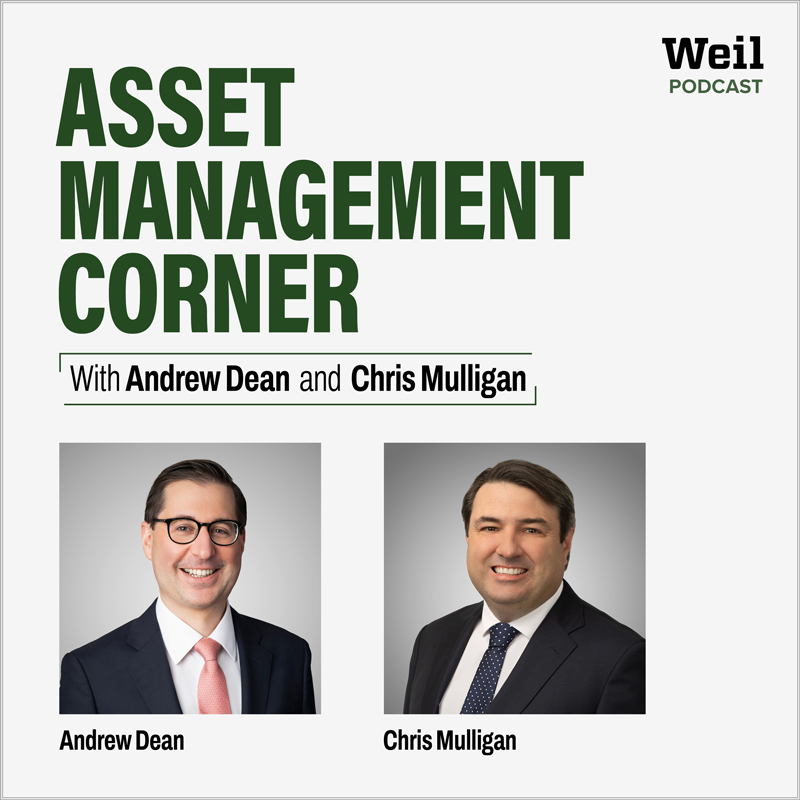
In this episode of Asset Management Corner, Andrew and Chris discuss the announcement of David Woodcock as the new SEC Enforcement Director, the proposed amendments to Form PF, and some notable enforcement actions. Then they are joined by Adam Huckle, a partner in Maples Group’s Regulatory & Financial Services and Dispute Resolution & Insolvency teams in the Cayman Islands. The guys discuss the critical role the Cayman Islands plays in the world of private funds, the fascinating history of the tax status of the Cayman Islands, and how Adam ended up with Chris and Andrew’s dream job. They finish by making their picks for the “Soccer” World Cup (which Adam couldn’t bring himself to say).
Stream here or subscribe on your preferred podcast app:


Transcript
Andrew Dean: Hello and welcome back to Asset Management Corner. We are your hosts, Andrew Dean and Chris Mulligan, partners at the law firm Weil. This is the podcast where we talk all things SEC compliance and enforcement. On today's podcast, we are joined by Adam Huckle, partner at the law firm Maples Group, which is based in the Cayman Islands. But first, Chris, a lot has happened since our last podcast — new rulemaking, new leadership. Where do you want to start?
Chris Mulligan: Let’s start with brand-new rulemaking. We’ve been predicting there are going to be a lot of deregulatory rules issued by this Commission, and finally we had our first one happen this morning — April 20. Form PF amendments were proposed jointly by the CFTC and the SEC.
The proposal is designed to eliminate filing requirements for small advisers, eliminate certain reporting requirements for smaller hedge fund advisers, and streamline and simplify other reporting requirements. Very important to mention: this is just a proposal, not a final rule. There will be a comment period, and a final rule likely won’t come until sometime in 2027.
At a high level, the proposal would raise the Form PF filing threshold from $150 million in private fund assets to $1 billion. It would also raise the threshold for large hedge fund adviser reporting from $1.5 billion to $10 billion. That’s a major change.
It also streamlines a number of requirements — eliminating certain volatility reporting, simplifying counterparty exposure reporting, removing some current reporting requirements, and eliminating quarterly event reporting for private equity advisers, including GP-led secondaries. That’s a big deal.
Again, this is just a proposal. There’s a 60-day comment period, and then the agencies will work toward a final rule.
Second, we have a proposal from the Department of Labor around democratization of private fund access in 401(k)s. This follows an executive order directing reevaluation of fiduciary duties around alternative investments.
The proposal lays out six key factors fiduciaries should consider — performance, fees, liquidity, valuation, benchmarking, and complexity — and reinforces that ERISA is process-based. If fiduciaries follow a prudent process, their decisions should receive deference.
The goal here is to address concerns that litigation risk is preventing fiduciaries from offering alternative investments. It’s asset-neutral and emphasizes process over outcome. We’ll see how impactful it ends up being.
Andrew Dean: Yeah, I’m really interested to see how that one unfolds. There are a lot of different interest groups at play there.
On the enforcement front, there have been several personnel changes. The SEC announced David Woodcock will be the new Enforcement Director. He’s currently at Gibson Dunn and previously led the Fort Worth Regional Office.
This is a very well-regarded, middle-of-the-road pick. He’s respected both internally and externally, and I think it’s a positive development for the Enforcement Division.
We also got the enforcement report for the last fiscal year, and the numbers were down significantly. The SEC emphasized priorities like individual liability, cross-border cases, insider trading, and market manipulation.
There have also been staff cuts — roughly 18% overall, including enforcement and exams. That’s going to have a real impact on activity levels.
On exam coverage, Chris, what are you hearing?
Chris Mulligan: We’re hearing exam coverage could drop to around 9% this year and stabilize around 11%, compared to roughly 15% historically. That’s a big shift — it means exams could be much less frequent.
Andrew Dean: Right. A couple of enforcement cases to highlight. One involves auditor liability tied to the Infinity Q matter — a major mismarking case involving complex derivatives. The SEC charged the auditor for failures around internal controls, valuation testing, and professional skepticism.
This shows the SEC is still focused on complex products and is willing to pursue gatekeepers.
The second case involves a robo-adviser with a 30% cash allocation that benefited an affiliated broker-dealer. The conflict wasn’t adequately disclosed, and investors potentially lost returns.
This is part of a broader pattern — undisclosed conflicts tied to how advisers make money. As AI becomes more involved in investment decisions, these cases may serve as a foundation for future enforcement.
Finally, the SEC issued guidance on crypto taxonomy, clarifying how securities laws apply to different types of crypto assets and transactions. It’s a significant development for those in the space.
Chris Mulligan: At its core, that robo-adviser case is another conflict case. The adviser had an incentive that wasn’t disclosed, and that theme shows up again and again across enforcement.
Now let’s turn to the interview. We’re joined by Adam Huckle from Maples and Calder in the Cayman Islands. Adam has extensive experience in regulatory and litigation matters involving investment funds and financial institutions. Adam, thanks for joining us.
Adam Huckle: Very happy to be here, Chris. Thanks for having me on.
Chris Mulligan: Adam, can you tell us about your practice and how it interacts with the private fund world?
Adam Huckle: The Maples Group is the world’s largest offshore law firm and fiduciary business, with over 2,500 professionals. We focus heavily on the investment fund industry, acting for a large percentage of global hedge fund and private equity managers.
My practice spans regulatory and litigation work. I handle contentious regulatory matters — enforcement, sanctions, inspections — as well as commercial and trust litigation. The two areas often overlap.
Chris Mulligan: Can you talk about your interaction with U.S. counsel?
Adam Huckle: We interact with U.S. lawyers every day. Most fund managers are U.S.-based, and structures often involve U.S. and Cayman entities. U.S. counsel typically have the primary relationship with the client, and we support on Cayman law.
It’s a critical relationship. If onshore counsel doesn’t trust you, they won’t refer work.
Chris Mulligan: What about Cayman itself — how is it structured and why is it so important to funds?
Adam Huckle: Cayman is a British Overseas Territory with its own government but oversight from the UK in areas like defense and foreign policy.
It’s a tax-neutral jurisdiction — no income tax, capital gains tax, or corporate tax. That avoids an extra layer of taxation at the fund level, which is why it’s so attractive for fund structures.
It’s also well-established, with strong service providers, a flexible legal system based on English common law, and a sophisticated court system. All of that creates certainty for investors and managers.
Andrew Dean: How did you end up there?
Adam Huckle: Honestly? I was standing in the rain in London waiting for a bus and realized I could do the same work in the Cayman Islands in the sun with no tax. So I moved.
It’s a great place to live — safe, family-friendly, outdoors-oriented, and easy to navigate. It’s essentially a first-world financial center in the Caribbean.
Andrew Dean: Last question — World Cup predictions?
Adam Huckle: England, of course — though realistically France or Argentina are probably the favorites. I’d say France has the edge.
Chris Mulligan: I’m going Spain.
Andrew Dean: I’ll stick with France. Adam, thanks so much for joining us.
Adam Huckle: Thanks for having me.
Andrew Dean: That’s a wrap for today’s episode. Thanks for joining us, and we’ll catch you next time.
Disclaimer: The information contained in this podcast is provided for informational purposes only and does not constitute legal advice. Listening does not create an attorney-client relationship. This podcast may be considered attorney advertising under applicable laws.

View more about Weil's White Collar, SEC Examinations, Private Funds and Securities Litigation practices.