Season 2, Episode 3: SEC Exams, Private Funds Enforcement, and…The Pitt
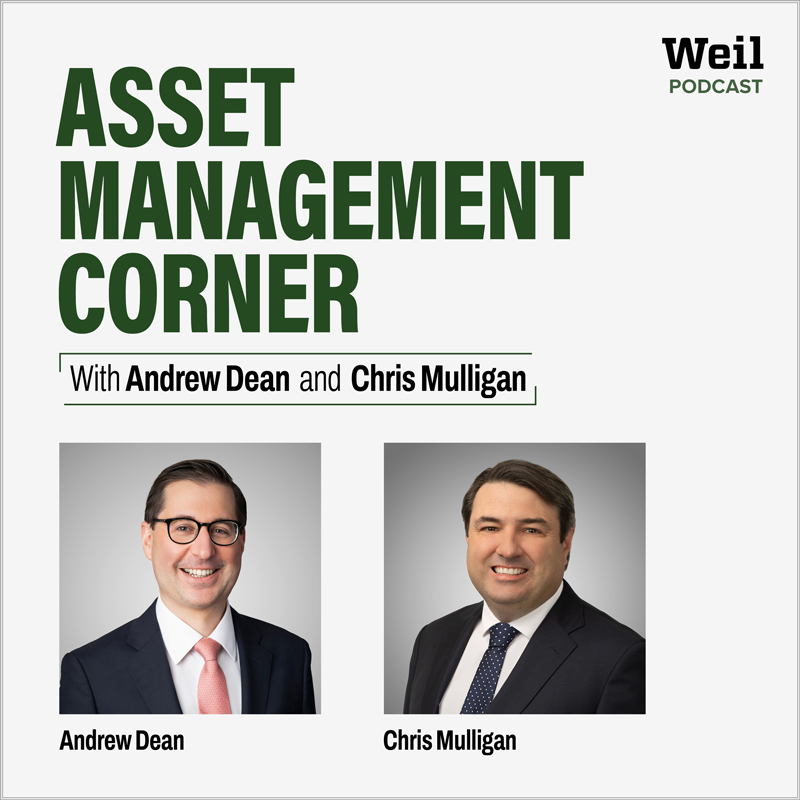
In this episode of Asset Management Corner, Andrew and Chris discuss another important Enforcement action involving a private fund adviser, the new SEC Enforcement Manual, and Enforcement Director Ryan’s first speech. Then they speak with Pete Driscoll, partner at PWC and former head of the Division of Examinations, to reflect on the evolution of Exams, discuss the SEC’s policymaking agenda, and analyze the importance of valuation in the retailization of private markets. The guys finish with a discussion of shows they’re watching, including a medical drama, a biographical romance anthology, and one of the few investment shows out there.
Stream here or subscribe on your preferred podcast app:


Transcript
Andrew Dean: Hello and welcome back to Asset Management Corner. We are your hosts. I'm Andrew Dean. He's Chris Mulligan, partners at the law firm Weil, the podcast where we bring you all things SEC compliance enforcement. On today's podcast, we're joined by Pete Driscoll, partner at PWC and former director of the Division of Examinations at the SEC, where Chris and I got to know Pete. But first, Chris, since our last podcast, we had a Super Bowl. Our picks were in. I was wrong. So I appreciate that. I'll spend that $2 somewhere. But let's get right into it because we've got a couple of things we want to hit on today. First, like late breaking, this is we're recording this on a Friday. Two new SEC enforcement cases just dropped. One of them involves the New York Stock Exchange and the outage from a couple of years ago. Folks can check that one out. But the case that I kind of really want to mention here is a case involving a market maker, broker dealer for failure to file SARS. For those folks who didn't think there would be sort of more technical cases brought by the SEC, well, here's one that might fit that category. And it's not a light penalty. It's a $20 million penalty and another $80 million in an action that was brought by FinCEN against the same entity. So again, we're seeing in the right circumstances, the SEC bring big penalties in cases depending on the facts. And this dovetails these cases with a speech by the new enforcement director, which is not really new anymore, but the enforcement director, Judge Ryan, her first public speech, and then the new enforcement manual. So we'll get into that too. So on the enforcement manual, we, like everyone else, put out a client alert on it. It's the first time since 2007, actually, that the SEC updated the manual. The revisions were, on the light side, not particularly significant. The way we read them was mainly memorializing and codifying long-standing practices in addition to some of the new SEC priorities. The judge also, in her speech, she talked about a couple of things that correlated with the new enforcement manual. And one of the big changes that we've talked about here and others and in our writings is changes to the Wells process. We know that there's going to be more time for potential respondents, defendants to respond. But what caught my eye, Chris, was some other statements that the judge made in her speech about it. She wrote in the context of defense counsel, she said, deliberate circumvention of the process, the Wells process, however, including tactical tardiness and other games will not be tolerated. Make no mistake, counsel's incentives financial or otherwise, to prolong an investigation and then complain about how long the investigation took will be met by steadfast commitment to reasonable and timely resolution. So judge wasting no time, making sure that defense counsel are on their good behavior when they're engaging with the staff the same way that the message is going out to the staff to give more time and also importantly, to make more available the record and other things to potential defendants, respondents. The other comment that I want to make from her speech is she did specifically address investment advisers, and non-fraud type cases. She mentioned in the context of her priorities, the Enforcement Division's priorities, as one of them, an investment adviser's obligation to adhere to its fiduciary duties and financial responsibility rules. That's a quote. And she went on to say that, quote, are violations of these provisions on par with fraud? No, not necessarily. In fact, I am confident that many violations of these provisions should not and do not result in enforcement cases by the commission. But there is a middle ground, she went on to say, where fraud is absent, but compliance has failed in a way that poses risks to investors, risks to the integrity of the market, or yields a benefit to the participant. So, e.g., the case that just came out today involving the failure to file SARS. So I think the judge clearly makes those statements in her speech. She clearly had these types of cases in mind. The other case, Chris, of real interest to you and me, and we've written an alert on this one as well, is the enforcement action involving Madison Capital Partners. In that case, I'll give you the brief and then we'll give you the takeaways on it. The adviser originated senior loans for PE sponsors doing M&A transactions and sold portions of those loans to the funds it advised. As is typical in these cases, the loans got a 30 to 60 day seasoning period before they were sold to the funds. The funds' advisory agreements and disclosures to investors, importantly here, stated that the adviser would price the principal transactions at fair value as reasonably determined by the adviser. The price was basically the par value minus some costs and discounts. Now, during the first months of the COVID-19 pandemic, the SEC's order found, as we all know, the markets faltered. The prices of everything were dropping across the board. But the adviser, according to the SEC, did not evaluate that price drop in the months during that seasoning period. So it was basically going to the fund without any additional review and instead just reliance on a third-party mark that didn't take into account anything else. So this is a big deal case for a lot of reasons. Again, it shows the SEC's focus on private funds as a general matter. We've been talking about it forever, Chris. This was a negligence-based 206(2) and 206(4)-8 violation finding. It shows that the SEC is going to continue caring about valuation cases. Valuation cases are hard at the SEC. They require, typically in the exam stage, valuation experts. The enforcement staff often brings on those and other experts during their enforcement investigation. And so advisers need to continue being attentive to their valuation practices, make sure they align with the stated policies. Obviously, a big focus on principal transactions, like there's a rule on that, 206(3), and the SEC views that as an inherent conflict. And so there's going to be scrutiny given to those transactions and making sure the disclosures match what's actually happening. This was a case where, and this is from a process standpoint, the adviser paid back $5.2 million in 2021 in connection with an exam. The SEC still brought the case. They still assessed a $900,000 penalty. That's a pretty meaningful case that I think this is the type of resolution you would have seen under any commission. It shows that you can't always get around an SEC enforcement action merely by remediating during the course of an exam. I think there are situations where you can. I think it just, you know, I think there are some violations that very well may be the types of cases that the SEC is still going to bring. I think that's the takeaway here. And it also shows that there's a long tail in enforcement. Like this was probably getting to the end of the COVID-19 era cases, the conduct happening in 2020, statute of limitations issues. But it also shows that when there are market dislocations, it does take time for those cases to wind through. And we've been talking about this forever. When there are market dislocations, valuation cases are pretty prominent. And we had the biggest mismarking case ever, Chris, that the SEC brought, one that I worked on, Infinity Q, that came out of the COVID-19 pandemic. And there were bad practices that happened around that time that led not only to an SEC action, but a criminal action as well. But Chris, I know you paid a lot of attention to this one. Any thoughts on this resolution?
Chris Mulligan: Yeah, I mean, I think there's a big picture takeaway, and then there's just a lot of really interesting details throughout the release that I'm still reading and sort of digesting. Big picture is I think this should be a wake-up call to the extent that anyone in the private fund world believes that this administration is not going to take sort of technical private fund specific enforcement actions or referrals from the Division of Enforcement. We've been talking about what we've been seeing behind the scenes, particularly the last eight, nine months from the Division of Exams and Division of Enforcement. But I think this just emphasizes the point that the world has changed at the SEC in some ways, rulemaking, crypto, off-channel communications, but for these fee and expense and valuation and technical issues involving private fund advisers, it has not changed, really has not. And in some ways, I think that you're seeing exams be more focused on these types of issues, less sort of distracted by some of those other issues that have gone away and are really locked in on these types of subjects. I think the short period of time that they held these assets, right, 30 to 60 days, really short period of time, and still finding the case, the fact that they voluntarily remediated during the exam and yet still endured a three, four-year enforcement action after repaying $5 million, I think is quite notable. And then there's just a lot of really interesting details in there. Like it is a principal transaction enforcement action, but they didn't charge 206(3), they had an independent trustee that was set up to approve these transactions on behalf of their clients. This was not a reckless firm. I mean, they'd had a process in place and the SEC did not challenge the sort of structure of that 206(3) consent. They didn't even charge 206(3). But what they said was that independent trustee relied on the adviser to provide the valuation and the adviser knew that. And so because of the events that happened during COVID, they didn't revisit whether or not they needed to write down the asset. I think the application of some of the lessons that are learned here to a lot of different topics, warehousing, cross-trading, is something that really people should think about. So big picture, the world has not changed that much for private fund advisers on these really important issues, vis-a-vis the SEC. And there's just a lot of things you can learn and sort of digest from the nitty-gritty of this release. And now on to the interview portion of our podcast. Today, we're delighted to be joined by longtime friend and former colleague, Pete Driscoll. Pete is a partner in the National Quality Organization of PWC, where he serves clients in the financial services sector. As a partner, Pete brings to clients his vast expertise at the U.S. Securities and Exchange Commission, where Andrew and I both worked with Pete, including examinations of investment advisers, private funds, mutual funds, broker dealers, and other market intermediaries. He has expertise in operational excellence as he teams with others throughout the National Quality Organization and PWC to promote standardization, centralization, and automation of aspects of PWC's broker-dealer audit and attestation work. As I mentioned earlier, prior to PWC, Pete was my boss as the director in the Division of Examinations at the SEC, where he led a team of over 1,000 accountants, attorneys, securities compliance examiners, and quantitative analysts responsible for overseeing SEC-registered participants in the financial markets. He spent 20 years at the SEC gaining exposure to key market events and related risks and establishing relationships and credibility of the SEC across the marketplace. I can just tell you, Pete is just a great guy. I loved working with him at the SEC and he's had an amazing career since then. So we're just really delighted to have you join the podcast, Pete. Thanks a lot.
Pete Driscoll: I'm so happy to be here and lucky to be here. And honestly, Chris, I mean, I was the fortunate one to get to work day in and day out with you. Amazing counsel. You truly are the brainchild behind a speech that even this week I get compliments on when it goes to the role of the compliance department and the CCO and just the importance of it. And truly working on that with you was one of the highlights of my career at the SEC. That was really a meaningful impact that you and I were able to partner together with.
Chris Mulligan: Likewise, I remember that speech well. That was really, really fun about the importance of compliance. I think it's still floating around out there, and I hear about it sometimes as well. That was really fun. So let's start with your time at the SEC. Obviously, I mentioned you were director of the Division of Examinations, but you had a long career at the SEC before that. Can you just reflect on your time there, what you learned at the SEC, what skills you developed, and sort of what you were responsible for as your role shifted over your two decades at the SEC?
Pete Driscoll: You know, that's great. It was interesting. I started my career and I worked for about 10 years in the accounting world. I was at a Big Six at the time, and then I moved on to be a controller for a firm and then decided to go to law school at night. And this would have been in the late 90s. I'm aging myself. But what was critical about that is it was before Sarbanes-Oxley, it was before Enron, WorldCom. The SEC was a much more sleepy agency. I was a financial reporting person. And so when I started looking around to what I would do post-law school, I thought, oh, the SEC would be an interesting place just given my background. And I ended up joining the Enforcement Division as a staff attorney in the Chicago office and stayed in enforcement for about three years and brought some cases, but really liked the idea of the work that the exam program did because it was much more proactive. It was getting to issues and fixing issues before anything bad happened. And so there's great value in bringing a case against a defendant that committed some wrongdoing. But for me, I just found a lot of value in trying to fix it before it harmed an investor. And so that led me to move over to the exam side, where I was in that office until 2013, and then moved to D.C. and took a role as kind of exams' chief operating officer. I had tech, I had people, I had risk. It was during a time when we were really growing from a risk and quantitative perspective. And then saw a need, just based on all the growth we had, to form the Office of Risk and Strategy. And I became the first Chief Risk and Strategy Officer. Basically, we had had data people, we had quant people, we had tech people, we had risk people in several different pockets. And I felt that we really needed to bring those groups together to have a much more nationalized and collective and smart approach to information sharing as well as execution. And then I was very fortunate to serve as the director of the Division of Exams for about four and a half years under Jay Clayton and for the first part of Gary Gensler.
Chris Mulligan: It is incredible how much you learn in the Division of Examinations. I mean, out of my 12 years at the SEC, 10 were in exams, and just the people you meet and the issues you have to deal with every second of every day. It's a very fast-moving division. No offense, Andrew, but I think Division of Examinations is the best division at the SEC. Just a great experience and great place to learn. So you left the SEC in 2021 for PWC. Tell us about your role now and what sort of services you're providing to your clients now.
Pete Driscoll: Yeah, so I joined the national office, as you mentioned, and spend a lot of time supporting the audit practice. We audit close to 15,000 private funds, about 60% of the mutual funds and about 80% of the ETFs. And so we have a very strong asset and wealth management practice. I spend a lot of time supporting my partners and the teams, whether it be rule interpretation with new rules and proposed rules and final rules coming out of the SEC, whether it be through things that we're seeing from SEC exams. And then in some cases, it's rare because our clients don't get sued often, but enforcement subpoenas and things like that and things that the enforcement team is looking at. So I spend some time doing that and Chris will like this. I help them with custody rule consults because the auditors play a big, big role there. And a lot of the notifications from auditors, when they're required, would come to me at the SEC when I was there as director. And so I spend some time working on that. And then I spend about half my time doing consulting projects. I help investment advisers, registered investment companies, private fund advisers, and broker dealers on a whole host of things, whether it's registration, whether it's compliance projects, whether it's remediation work. And then I actually get to do some deal due diligence, which that was never on the radar when I started at PWC, but that's been a really fun experience just as deals have heated up, doing due diligence when it comes to acquisition of an investment adviser, broker dealer, or some other financial services firm.
Chris Mulligan: I remember just a few conversations about the custody rule with you over the years. So moving on, you have such an interesting perspective because you have been in the Division of Enforcement to begin your career, then Division of Examinations, as you said, at a time when it was very different, much smaller, much different, and then see it through a huge technological change and growth in the 2010s when I was there. And now you're on the other side of it, seeing it as an adviser to market participants. So you just have such a unique perspective. How do you think SEC examinations, particularly of investment advisers, have evolved and changed over those two and a half decades that you have been deeply involved in it?
Pete Driscoll: Yeah, it really has just grown in a way that is pretty impressive. And I think it's consistent with the growth and maturity that the industry has experienced. Our use of data. We hired close to 20 quantitative analysts, which honestly, they're really technologists. So it really drove technology development at the SEC and different tools and processes that we used to, at the time, make us better and make us more efficient and effective. Risk, we spent a lot of time trying to improve a national approach to understanding risk, not only in the markets, but also at various firms to help scope. As you can imagine, there are certain factors in the private fund space that trigger a higher risk potential, whether it's a prior history of exams, whether it's obviously custody, which that's always kind of a risk factor. If they have access to client money, it's going to be something that the SEC is going to focus on more. Whether it's a new rule implementation, I mean, like we've seen a lot of, and I know that this is near and dear to your heart as well, is the marketing rule and just the impact there. It's different from retail marketing, and so trying to apply those rules to the private space can be difficult just given the differences. Advancements in tools such as Trade Blotter Analytics, so the development of NEAT, the National Exam Analytics Tool, like that didn't exist in 2010. And it was something that was developed once we hired quants. And before that, we were using Excel, Microsoft Excel, and Microsoft Access, which had space limitations. And we couldn't do near the amount of queries that we could do with the NEAT program. And then it's something that a lot of people don't know is back in 2010, 2011, particularly under Carlo Di Florio's leadership, we added a lot of governance, similar to what industry has. So we added an executive committee, an operating committee, a risk committee, exam process committee, and technology committees to put in place some governance and some guardrails, as well as getting input from a lot of the regional offices. So we're not, from a D.C. perspective, pushing down certain technologies or processes that aren't workable out in the field. And then we pulled together an exam manual. So I think a couple changes too: hiring of expertise, like a number of your former podcasters that have been on. So Scott Walker from a digital asset crypto perspective, Jen Duggin, Zenia Rosenblatt, from a private funds perspective. Hiring folks like that, I think, was really critical. We also hired valuation experts, which are still there and provide a lot of value to the baseline examiner. And then the development of the EERT led by Adam Storch. It's basically a market response team when something is going on in the markets, whether it be geopolitical, whether it be cyber related, whether it be just disruptions in terms of market volatility. So it's just a much more sophisticated place from when I started back in 2004, where we used yellow notepads and carried around a bunch of folders of paper. It's all electronic now.
Chris Mulligan: Absolutely. Certainly the 2010s and under your leadership was a time of, I think, great change at the Division of Exams. Rulemaking, people think of it as being for the policy divisions, and that is true mostly, but I will say exams has a seat at the table for rulemaking. And then, of course, after rules are finalized, the burden is really on exams to train examiners in the new rules, figure out how to implement this rule that's just on paper. It's just on paper. And how is that going to kind of transition into the real world? What are we looking for? What are we doing? So rulemaking has a really big burden on exams. And I think in some ways exams is sort of positioned not all that differently than industry. We're all trying to learn the rules and all trying to train up on it and figure out how to apply it in our respective roles. And you were the director under the first Trump administration. And there was a lot of attempt to have deregulatory rules. I think an example of how challenging rulemaking can be is the marketing rule. People don't really remember it was an attempt to reduce the burden of the old advertising rule. I'm not sure people quite feel that way today, but that was a rule that was adopted by Chair Clayton under the first Trump administration. Trump is president again, and we have a desire to have a deregulatory rulemaking agenda. We haven't really seen any major rule proposals yet. We expect them to come in the not too distant future, but they certainly flagged some of the topics that they are interested in. I think, as you and I both know, making a rule less burdensome is sometimes not nearly as easy as that sounds. But I would love your thoughts on the current rulemaking agenda and if it brings back any memories from our time together under the first Trump administration.
Pete Driscoll: You bring up a great point, just the intent of, say, marketing, like principles based, moved from all these long-dated no-action letters, hadn't been updated since the 1960s. And then it gets updated and it's all in the application of how it's enforced. And you're writing a rule for 15,000-plus advisers. Some are retail, some are small, some are large, some manage mutual funds, some manage private funds. And so trying to get a rule that applies to that huge swath of registrants, I think it is an art. Right now, I think you mentioned there's just this huge push on providing guidance, whether it be through rules, whether it be through interpretations and statements in the digital assets and crypto space. We're seeing a lot of movement there. And that flows to the Reg Flex agenda where they're looking at doing offer and sale of crypto assets, the custody rule. I mean, there's a lot to be updated in the custody rule just as things have progressed in the markets. But I think that's a driver. The transfer agent rule, that fish has been flopping on the deck for over 20 years. And we almost got it out and amended back in 2019, but it didn't go. It just wasn't a priority. But crypto may get us over that edge to update that rule. Tokenization of securities, like that statement that came out a few weeks ago from Corp Fin, IM, and TM. It was a good move by the agency to put out some guidance just that the laws do apply in this case. But I think that's going to, you start tokenizing securities, it's going to transcend our existing markets and allow for people to participate in securities markets that may not have a brokerage account in the U.S. with a U.S. broker. And so that triggers, as you know, all the AML stuff, KYC and things like that. One trend that we saw under Jay Clayton, he was very sensitive about bringing in a lot of data because it made the SEC a big target for cyber criminals. That changed under the Gensler administration, where it was full force, as much data as you can bring in. And I think we're seeing a reversal of that now and a pullback. You saw some moves with the consolidated audit trail. You saw the import rulemaking come out just a few weeks ago and just what that does. I think T+1 will probably be impacted by that. You saw a lot of extensions of compliance dates and things like that. And then cross-trades, I think, is something that the industry has found challenging, particularly in the registered space.
Andrew Dean: Yeah, no, it's funny. We just went through a lot of agenda and it actually, Pete, as you're going through things, there's like a lot of plumbing that needs to be fixed right in the markets through the rulemaking. And we didn't even really get to retailization, which is one of the big topics du jour. And earlier this week, as Chris said, the SEC hosted a private markets forum. You were on one of the panels. I caught your panel. I still want to catch the earlier panel. I heard it was a good one, entertaining one to watch. A lot of discussion on your panel on valuation. I found it great. The video is going to come out at some point. Encourage folks to watch it. For those who didn't see it, what's the takeaway? On the valuation piece, and private funds, right? You've got registered funds, you've got private funds. What is the big takeaway that you have for people on that topic?
Pete Driscoll: Yeah, so I think there's been a lot of talk, like you all probably have been, living and breathing the retail of alts discussion, whether it's talking with the registered space, whether it's talking with alternative investment advisers, whether it's talking with recordkeepers and 401(k) platforms, trying to be responsive to the president's executive order when he came in. I think the big takeaways are that, look, they've been valuing Level 3 securities for a long time. There are rules in place. There are sophisticated service providers that have filled some of the gaps in terms of information flow. There are certainly challenges at times, both price challenges, but also challenges with properly valuing a security. And I think as more alts end up in public funds, the move to either a daily NAV or a more frequent NAV is going to lead to an increase in cadence and governance that needs to be put in place for these firms to get used to it. Historically, the alt space is either monthly or quarterly in terms of marks. And I think as they launch retail funds, they're going to move to a daily NAV strike. And you see, I mean, it's a proven path with the interval funds. We've seen that for a number of years and it works. And so I think one of the big takeaways is that you have this process that's refining and has been in place for a little bit. It's going to increase because I think there's a big push there. And so for certain firms, particularly in the alt space, think about the compliance rule. 38a-1 is the compliance rule for the mutual fund space. 206(4)-7 is for the alt space. As the alt firms start launching 40 Act funds, they're going to need to update their 38a-1 programs. And they're also going to have a lot more obligations from a board perspective on the public funds that they're really not probably having to do in the alt space. So I think thinking about that, thinking about the marketing rule and how that applies, moving from marketing through pitch books to marketing through public funds and a much broader audience. One thing that I've been talking about, and I'm sure your firm is great at this, is if you read the fund docs on these products, they're so well written. They disclose all the risks. The risk isn't with the producers of these products. I mean, sure, certain things can happen that are isolated or could be at fault for one firm. Systemically, though, I think the risk is going to be in distribution. It is going to be that sales rep selling that product to somebody, and it's not in their best interest, and it's not suitable, whether it be based on age, whether it be based on future cash needs. I think that's been my one takeaway. One thing that's a surprise to me, like we're all 40 Act attorneys, but where I think the industry is really headed right now is moving to the CIT space, because it's easier to facilitate multi-strat in those. And a lot of the plan sponsors for 401(k) plans that are going to carry, a lot of it's life cycle funds right now. And I think the one thing that's really surprised me is just how everybody in that retirement space is talking about launching CITs that include the alt space, which to me, I just naturally think about 40 Act funds just because of my background, but that was a surprise to me. And that was mentioned a little bit yesterday. It wasn't fleshed out because it was an SEC-sponsored event, whereas CITs are banking regulators.
Andrew Dean: Fascinating, fascinating. Well, it was a great panel. Again, encourage people to catch it when it comes out. Pete, we're going to mix things up on you here. We're doing a new segment on Asset Management Corner. Pete, what are you watching? What are you streaming right now? What's on your saved list on your device?
Pete Driscoll: So I'd like to say something really smart and intellectually challenging, but there's two things I'm watching now. One's The Pitt, which it's about every hour of a day. And when I think I'm having a bad day, I watch that and see some real perspective in terms of what people are dealing with. And then I just started watching, just on a whim, a show on Apple called Tehran. And it was before a lot of this took off in the last week in terms of what's going on in Iran. It just so happened to coincide. And it's a spy type of show.
Andrew Dean: Love the spy stuff. That's good. I watch The Pitt too, Pete. Half the time I'm watching, I have to put my hand up to block whatever surgery is happening on the screen. I'm a little too squeamish for some of that stuff. So Chris, how about you? Let's rope everyone into this. What are you watching?
Chris Mulligan: So I haven't started watching it yet, but my wife is really into this new JFK Jr. show that's on FX. It's about Carolyn Bessette and JFK Jr. And I know she's watching it a lot because she sends me a lot of texts about clothes that I should be buying that JFK Jr. wears. I think she's saying I need to step up my fashion game a little bit. So she says it's really good. So I'm looking forward to watching it and getting some fashion tips from JFK Jr.
Pete Driscoll: You got the good hair too, Chris.
Chris Mulligan: I mean, you got JFK hair. I wish I had.
Andrew Dean: It sure does.
Chris Mulligan: Yeah.
Andrew Dean: Full mane.
Chris Mulligan: I like the suit with the backwards hat riding the bike through Manhattan. That's a cool one.
Andrew Dean: That's great. I've been watching, I probably should stop because it feels like it's fallen off the rails a few times now, the HBO show Industry, which there's not a lot of shows out there about the financial markets. And it's one that I've been watching since the beginning. One of the few that's left after Succession has been off the air. So I've been watching that one. I don't know how much stronger I'm going to recommend it, but I'm all in. I've got to get through the rest.
Chris Mulligan: Last season was good. This season is rough. I've been watching that too.
Andrew Dean: Yeah, I just don't. Yeah.
Chris Mulligan: Last season was very good though.
Andrew Dean: Yeah. All right. Well, Pete, this was fun. Thanks so much for coming on and we'll catch up with you soon.
Pete Driscoll: It was a real pleasure. Thank you both. And please keep the podcast going. It is a great listen and you guys are real crisp about it and it's just a terrific thing. If you want cutting edge issues, recent cases, recent trends, some real experts that come on. Really nicely done, you guys. Please keep it up.
Chris Mulligan: Andrew, we're booking Pete again.
Andrew Dean: I know. He's going to be a repeat guest.
Pete Driscoll: You need time. All right.
Andrew Dean: Thanks, Pete. All right. Thanks again to our guest, Pete Driscoll. Thanks for joining us on this edition of Asset Management Corner, and we'll catch you next time. Take care.
The information contained in this podcast is provided for informational purposes only and does not constitute legal advice. Listening to this podcast does not create an attorney-client relationship. You should consult a qualified legal professional with any questions. This podcast may be considered attorney advertising under the law of certain jurisdictions.

View more about Weil's White Collar, SEC Examinations, Private Funds and Securities Litigation practices.